CER is claim-evidence-reasoning. This process requires kids to make a claim, support the claim with evidence or data, and explain their reasoning or thinking. Edutopia has an introduction to CER. Next, you will want some examples and a slideshow. When I introduce kids to the idea of CER, I use Slide 19 in the slideshow just linked. I broadcast the data table and ask kids if all the liquids are the same. They study and table and say whether or not the liquids are the same. The key is to lead the discussion to get the class to articulate their reasoning based on the evidence posted in the table. Get in the habit of asking kids to support their claims with data.
Wednesday, April 29, 2015
WA and Apologia Science: CER
CER is claim-evidence-reasoning. This process requires kids to make a claim, support the claim with evidence or data, and explain their reasoning or thinking. Edutopia has an introduction to CER. Next, you will want some examples and a slideshow. When I introduce kids to the idea of CER, I use Slide 19 in the slideshow just linked. I broadcast the data table and ask kids if all the liquids are the same. They study and table and say whether or not the liquids are the same. The key is to lead the discussion to get the class to articulate their reasoning based on the evidence posted in the table. Get in the habit of asking kids to support their claims with data.

Apologia Chemistry Module Eleven Solubility
The Apologia chemistry textbook, Experiment 11.2, The Effect of Temperature on the Solubility of a Gas gave me an idea for an inquiry-based lab. Last fall, a fifth grader at WA, Julia, wanted to test her hypothesis that hot soda goes flat faster than cold soda. I was helping the fourth and fifth graders understand the science fair process. When Julia explained her idea, it occurred to me that I had a CO2 sensor, part of a set, a Pasco rep. had given me after a conference which I had never used. Ever. Julia and I were able to trouble shoot the apparatus. Now, that I have learned the quirks of my Sparklink interface, I have lost most of my inhibitions about tackling new sensors. Here are some screen shots and a photo.
In any case, Experiment 11.2 can be adapted to an inquiry based lab, using CER, claim based evidence. In other words, we used Julia's science fair project to examine gas solubility in solution. My Chemistry kids spent some time discussing gas solubility with a coke can as a prop. Once the kids could articulate that carbon dioxide gas would fizz faster from a warm can of soda than an ice cold can, they were ready to start. I demonstrated the CO2 sensor, took it completely apart and made them reassemble it and connect the iPad with its app to the Sparklink. Then they brainstormed ideas. I made a few suggestions, such as using the same container for the bath and creating a room temperature water bath instead of testing one outside of a water bath. When they asked what room temperature was, I pointed to the temperature probe collecting data. I also had to ask them how long would they collect data and how long would they allow their cans of soda to equilibrate. Once completed, the kids wrote a formal lab report. They are finishing these for homework. Before, during, and after the lab, I asked the kids a few questions: What is the purpose? What are potential sources of error? How does gas solubility change with temperature? The kids should answer these in their labs. Just as a review, for me a standard lab report has a title, purpose, materials, procedures, data, discussion, and conclusion. A standard conclusion is that more trials are indicated.
This lab provides an opportunity for CER, claim-evidence-reasoning. This CER example provides a model. For this experiment, the claim is that gas is least soluble in very hot water and most soluble in a solution which is very cold. The dissolved oxygen concentrations are highest on a cold winter day. The evidence for this claim is that a can of soda in very hot water produces more CO2 than a can of soda in ice water. The reasoning has to do with the gas solubility in solution or more gas remains dissolved in solution in icy water than in boiling water. CER requires logic and critical thinking. Kids hate this process. It's hard work. I love CER. Here is a process to get kids to think through a project and articulate their findings.
WA and Apologia Physical Science Electricity
Both of my Physical Science classes are doing the same lesson on Electricity with the same labs and activities. I also teach Chemistry, Earth Science, and Life Science at a Co-op and a small, private school. It was a little nuts! So, to save my sanity, at least one subject is on the same page. The time-lines and concept maps are in various stages of completion in both sections. This is completely normal. Kids are absent; some just take longer to do written work. These two assignments are being completed on an electronic device. (Two groups asked to create their time-lines on graph paper. They did not want to invest the extra time to research how to create a time-line in Excel. Fine.)
We did three activities for static electricity with sticky tape, balloons, and an aluminum pie plate. The first activity is with sticky tape statics. This involves three pieces of tape. Stick two to a kids shirt. Remove the tape and hold the two pieces slightly apart; they repel. Take a fresh piece and hold it to one of these pieces of tape. All I want to reinforce is that like repel and opposite attract. Static Charge on a Piece of Scotch Tape describes the underlying science. Knock yourself out! I ask the kids to tell me what static electricity is. Be sure to ask the big questions.
This week I wanted the kids to play with Squishy Circuits. That lasted five minutes. Once they were able to light an LED bulb, they were done. I know better! The kids need a specific challenge! Here are photos of the kids at work. What did I do differently? I gave them a specific task. I had made copies of Circuits and the Flow of Electricity Lesson . I made sure they could differentiate between a series and parallel circuit and then told them they could use any of the materials in the box to make both types of circuits. Then I let them loose. My box contains several types of bulbs and batteries, electric tape, clothes pins, alligator clips, paper clips, brass brads, etc. the kids also had the conductive clay from the squishy circuits. Then the kids went to work. I only interrupted long enough to take a few pictures because it my interference can block this sort of productive activity. The moral is to be sure to give kids a specific task, one which is not too open-ended.
Saturday, April 25, 2015
Apologia Chemistry: Acids and Bases
Our Co-op had an extra class to make up some ground. This past winter was brutal. The kids did a serial dilution with dilute HCl and NaOH. The students set up two sets of test tubes, each containing 9 mL of water. We prepared two solutions: 0.1 M HCl and 0.1 M NaOH. The kids remove 1 mL of th0.1 M solution and add it to the first test tube, stir, and remove 1 mL from the next and so forth. After the dilutions, they add half strips of wide range pH paper. The idea of doing a serial dilution with pH paper is for the kids to see the correlation between pH and concentration. Well, they don't. I had them record their data in this manner, drawing test tubes with the dilutions and pH. Afterwards, I showed them how to calculate pH using a calculator, they seemed to see the relationship.
I think it is good for kids to prep solutions. I make a point to show them how to label the secondary containers with the formula, molarity, date, and initials. I walked the kids through the process of using M1V1 = M2V2 for both dilutions and titrations. As the kids did their Titrations, they noted that something was wrong with the acid concentrations. The stock solution of HCl indicated that the
concentration was between 32% and 36% or 10.17 M and 12M. I prepared the acid solutions because the stock solution is so concentrated. I ended up making 0.1 M solutions twice, once assuming 36% and a second time using 32%. The kids repeated the titrations. The acid was not at full strength. Not quite the lesson I planned to instruct. I wanted them to understand the process of titration with phenolthalein, HCl, and NaOH. They used logic to deduce the acid strength was off. Sigh. At least they got a number of titration trials.
Friday, April 24, 2015
Apologia Physical Science: Suishy Circuits
The Physical Science class began Electricity on Wednesday; our class had an extra lesson this week owing to the number of snow days this past winter. In an earlier post, I mentioned that the kids are working on concept maps and time-lines. This morning they made the play dough for Squishy Circuits. We have had mixed results getting the bulb to light. One student, L. reminded me she had tried this earlier for her Science Fair project and gave up in frustration. Last summer, the squishy circuits didn't work either. But, one group from my high school class had gotten them to work once; but, it did involve a great deal of profanity and numerous trials.
Today, L. and O. decided they would rather finish their time-line of scientists than experience the frustration of squishy circuits. But guess what? P. got it to work!!! A nine volt battery will blow the bulb and two AA batteries are not enough. P. used four AA batteries and reduced the amount of conductive clay. Here is proof!
Today, L. and O. decided they would rather finish their time-line of scientists than experience the frustration of squishy circuits. But guess what? P. got it to work!!! A nine volt battery will blow the bulb and two AA batteries are not enough. P. used four AA batteries and reduced the amount of conductive clay. Here is proof!
Wednesday, April 22, 2015
WA Life Science: Dissections II
My Life Science class is comparing different animal phyla. My approach is pretty traditional. The class is using MRS GREN in a chart to compare representative animals in nine major animal phyla. The kids just started to dissect. I ordered animal survey sets: earthworm, clam, starfish, crayfish, oerch, and frog. I posted some resources for dissections in an earlier post; it won't hurt to assemble some resources again. I keep loads of references out as the kids dissect, including photos of dissections.
I believe in dissection packets, especially those that make the kids examine their specimens more closely. The Biology Corner has dissection guides and links to virtual labs. Virtual dissections can be useful, if funds are tight or for a child home-bound for illness or a family crisis. Home-schoolers may elect to supplement a few selected dissections, such as the earthworm and frog with virtual dissection labs to stretch their school budget, especially large families. I am old-school and believe kids need to dissect.
Here are the packets we are using: Earthworm, Clam, and Starfish. This Imgur album has some photos of my kids dissecting and a copy of the MRS GREN chart they are completing to compare nine major animal phyla.
WA Life Science: Dissections
Finalky the kids started a series of dissections. Earthworm Dissection Packet is similar to the packets the kids are completing as they work through the survey of animals. This process is part of comparative morphology, examining different traits or characteristics of animals both simple and complex. Check out this example of the earthworm specimen.
Apologia Science: Technology and Probeware or Sensors
Technology! Again? I know, I know! Your Co-op should not be intimidated by Pasco or Vernier probes or sensors. Cost is also not a barrier. Some of the older technology is fine. eBay often sell Pasco's GLX Interfaces and sensors. The GLX pictured predates AirLink and SparkLink interfaces. Most of the Pasco sensors are compatible with the different interfaces. While I have never found any of these devices to be intuitive, my students do! I hand them a device, show how to turn it on, and explain that if they get stuck to hit the little house icon for 'home'. GLX Labs are widely available on the web. There are plenty of resources and the Xplorer GLX is very sturdy. Take a look at the ease of operation.
Apologia Chemistry: More Titrations
There are apps and virtual titration labs and the Utitrate app is free. The problem for a neophyte is that too often the whole titration concept is foreign. So an app or virtual lab isn't necessarily going to help. Scientists use Titrations to determine the concentrations of unknown substances. Many test kits are back Titrations. The idea is to neutralize an unknown concentration of a solution with a known concentration.
Apologia Chemistry: Acids and Bases
Acids and bases are familiar chemical compounds and students enjoy these experiments. Our Co-op is going to do acid-base titrations using microscale techniques. Typically, titrations involve liters of acids and bases and an expensive buret. Microscale uses small, dilute volumes of acids and bases, making this safer and practical for Co-ops or schools on a tight budget. Microscale Acid Base Titration is a good example of the type of titration ordinarily performed in a chemistry class.
Vernier's Microscale Acid Base Titration lab works well if your class has a pH probe, EasyLink, and a TI 84 graphing calculator. Vernier's pH probe can be connected to a laptop with a Go! Link and free Logger Lite software. I have had good luck buying used probes and links on eBay.
This video has a brief introduction to microscale techniques.
Apologia and WA Physical Science: Circuits
Once the kids are grounded in the fundamentals, let them create circuits. I am using Consumer Energy's circuit lesson because the photos are clear and it employs simple materials. I have a copy of TOPS Science Electricity and have used aluminum foil, clothespins, and tape to create circuits. You might try both methods. Once the kids have the idea, we are going to make Squishy circuits with conductive and nonconductive clay. Last summer at Mad Science Camp, they did not work well. I had kids in one of my chemistry classes use squishy circuits for their science fair experiment and were able to get the LED bulbs to light. It took a number of trials and batches of clay. We are going to give it another shot. Stand by for the results.
Apologia and WA Physical Science Conduction
The Co-op Physical Science class started Module 12, Electricity. One student demonstrated static electricity by rubbing a balloon on his head to pick up ground pepper. There was a storm approaching and the atmosphere was quite humid. It took a great deal of static for the balloon to pick up the pepper. The moral is to do static demos on dry days.
Happily, the kids did do several other activities. (See the screen shots on the imgur file.)
I use a 5 E Lesson Model and the first step is to engage the class. The kids launched Pasco's conduction lab on SparkVue to see how to create a simple circuit and collects data with the voltmeter. If you don't have much background in electricity, have your class follow the directions step by step using the materials listed in the experiment. I like to create more open ended experiences and provided a huge assortment of materials to test: cork, keys, ping pong balls, coins, chalk, graphite, wood blocks, etc. Next they created a data table listing the object, their prediction, and whether or not it was or was not conductive. Some of the kids used the voltmeter to record each object. Two of the kids made a simple circuit with a light and used it to test conductivity. After the kids had tested ten or more objects, they drew simple conclusions. Just one more note. Steel wool can ignite with a battery.
After the kids did this exploration, they worked in groups to creat concept maps and to begin a timeline in Excel. Look above at the link marked 'activities' to see an example. There are free apps to use to create concept maps as well as free spreadsheets for the time-line. I use concept maps for key terms. Creating time-lines in Excel is another way to inject a little technology into your lessons painlessly. Timelines are useful outside of History lessons. Managers and event planners create time-lines to manage projects. Besides, the kids can listen to music as they organize the scientists chronologically to liven up this lesson.
Apologia Chemistry: Acids and Bases Series Dilutions
Most people know that the pH scale is a measure of acids and bases; acids have a pH below 7 and bases are above 7. The pH system is based on logs; each interval is a factor of ten. One way to help kids see the relationship between concentration and pH is to create a series dilutions for both 1 M HCl and 1 M NaOH. At the moment, I have 0.5 M hupydrochloric acid and am out of wide range pH strips. When the order arrives, the kids will do the dilution. I have the kids set up the dilution and after put small pieces of the test strips in each test tube. They may use a pH sensor as well. Set up seven test tubes for HCL and seven test tubes for NaOH. Add nine mL of water to each test tube. Next extract exactly one mL of 1M HCl and mix it into the first test tube. Then remove exactly one mL from this test tube and put it in the next. This video demonstrates the technique.
Apologia Chemistry: Module Ten Acids and Bases
Today, the Chemistry classes started a lesson on acids and bases. Dr. Wile has a simular experiment in Module Ten. My version on Household Acid and Bases is my way to hook or engage students. I rummaged through my stash of travel size products: mouthwash, shampoo, hand sanitizer,etc. Next, I shop my kitchen for lemon juice, apple juice, soda, baking soda, etc. Finally, I sour the bathroom for Epsom salts, rubbing alcohol, basically, any clear substance. The kids use reaction plates to test each product. Solids must be dissolved in water before testing. If you click on the link above, there is a picture of the chart I use for this lab. We had used up all of my pH paper and universal indicator earlier. I did have phenol red and phenolthalein, PHTH. The kids used the PHTH which is clear in acids and pink in bases. After they did the tests, I gave them a Vernier pH sensor which connects directly to a TI 84 graphing calculator with an EasyLink, using EasyData, a software program preloaded on the TI 84 calculators. The kids also recorded the pH for each substance. I like the kids to make summaries to draw some conclusions. In the next lesson the kids are going to learn how to dilute acids and make solutions of different molarities or concentrations.
Monday, April 20, 2015
Apologia and WA: Physical Science Conductors and Insulators
After the kids have a grasp of static electricity and can explain why clothes cling to wool socks in the dryer, it is time for the next key concept: conductors and insulators. My kids are going to use Pasco's sparkvue lab with a volt meter. But, you don't need special equipment. This Conductors and Insulators lab uses very simple materials to make your own volt meter. Gather paper clips, clothespins, erasers, rubber ands, brass brads, etc. in advance. Tops Science Electricty is another resource which uses tape and aluminum foil instead of alligator clips. There are virtual conductor labs to try, especially if your child has a profound learning difference. She can use the virtual lab as direct instruction or as a test of her understanding of insulators and conductors. The best section overview of Electricity is in Exploring Creation with Chemistry and Physics. These activities are perfect for an introduction.
Apologia and WA Physical Science: Electroscope
Another cool way to understand static electricity is by making an Electroscope or static detector. Anytime you are performing static electrical experiments, be sure to pick a dry day. The best time to study static is on a dry day in winter, when your hair is crackling as you remove a wool cap. One good question for kids is to ask why a nylon slip sticks to a wool sock in the dryer?
Why do clothes cling to a wool sock in the dryer? The short answer is static electricity. Have the kids probe a bit to understand why electrons build up in a hot dryer.
Apologia and WA Electricity: Resources and Ideas
Once the kids have worked through the module, created a cmap and time-line, it is time to start the activities. My kids begin with static electricity and strips of cellophane tape. How Do the Pieces of Tape Interact?. The second activity on this link bends water. I love this demo. Create a very thin stream of water. Charge a glass rod or balloon with static electricity by rubbing it on your hair. Hold the balloon or glass rod next to the stream and watch the stream bend towards the balloon. Be sure the demo is conducted on a dry day; if high relative humidity can interfere with the static charge. Here is a video which explains this in detail.
Apologia Physical Science, Experiment 12.1 tests Electrical Attraction and Repulsion with balloons and tape a bit differently.
Apologia and Physical Science: Electricity Module 12
Electricity, finally! This unit has loads of potential for hands-on labs and activities. However, the kids need fundamental terms, key concepts, and some background. Hence notes, concept maps, and time-lines. Yes, a time-line! Famous Scientists contributed to our present understanding and many electrical terms, such as volts, ohms, and amps derive from their names. (See the earlier post for time-lines. I require birth, date, and major contribution with each scientist color coded on graph paper.) The kids should be familiar with these key terms: photons, conduction, induction, electric current, circuit, resistance, static charge, electric cell, conductor, insulator, electric potential, grounding, electric charge, electric field, volt, ohm, ampere, Ohm's Law, resistor, series circuit, parallel circuit, and voltage source. This is a good time to add a bit of technology. Have the kids create concept maps or cmaps on the computer or download a free cmap app for iPad. Once again, here is a video explaining how to creat a timeline in Excel.
Apologia Chemistry Module Ten Acids and Base
This week, we are having an extra class to catch up on Friday because we missed some classes owing to inclement weather. Finally, we are beginning the lesson on acids and bases. Prepare the materials in advance: mouth wash, shampoo, hand soap, baking powder, lemon juice, Epsom salts, alka seltzer, apple juice, sudsy ammonia, etc. Locate clear liquids. Any solids, such as table salt or Epsom salts must first be dissolved in water before testing. The kids may use pH paper or red and blue litmus paper. They first create a chart listing all of the solutions or solids to test. Feel free to make them write their formulas as review. The kids should then write their prediction. Is the solution an acid, base, or neutral substance? Now, the student should test each compound and record whether or not it is acidic, basic, or neutral. Did the kids make accurate predictions? Which type of materials are likely acidic or basic? Have them draw conclusions. For example, cleaners are generally basic. Ask the kids why one puts an open box of baking soda in the fridge? Odors tend to be acidic and baking soda, a base, captures and neutralizes odors. The kids usually like this lab.
My friend sent this hilarious video I am sharing again.
My friend sent this hilarious video I am sharing again.
Apologia Chemistry: Lewis Structures
Dr. Wike does a terrific job explaining Lewis Structures in the text. Just in case this is confusing, here is a video breaking them down into five easy steps.
Apologia Chemistry VESPR Module Nine
This week, the Chemistry Co-op is going to tie electron configurations, Lewis Structures, oxidation numbers, and VSEPR together. First, the kids are going to review electron configurations for specific atoms in selected molecules using the short-hand notation to highlight the number of valence electrons. Next, the kids are going to draw Lewis structures and make note of the valence electrons involved in bonding and those which are not bonding or 'unshared'. The oxidation number represents the number of electrons bonding.
Once we have a handle on writing the Lewis structures, I am going to introduce Molecular Geometry and VSEPR theory. I built molecules to show some of the standard shapes. Hopefully, the kids can video the entire process including the molecules. In the mean time here are the resources I am using for this lesson.

Apologia Organic Chemistry Models
Apologia Chemistry: Summary of Organic Chemistry
Why did we detour last week into Organic Chemistry? What does Organic have to do with Modules Eight and Nine? Good questions. I wanted my kids to build molecular models. They have a pretty good grasp of electron configurations. Now, the trick is to lead them into Modules Eight and Nine. So after a crash course in organic nomenclature (IUPAC), the kids used these molecular kits to build models. The models allow them to see the bonds holding the molecules together, to ask why carbon has four holes and hydrogen only one in the ball. Most of all, the kids see that molecules are three dimensional. One last molecule.
Friday, April 17, 2015
WA Earth Science Oceans
the Earth Science class is doing several programs simultaneously: the class material, the Soar grant, instructional prep, and immersion into technology. This week the class reviewed two of the slideshows fromPrentice Hall PowerPoint slideshows. The kids are working through material and e-modules Cacapon Institute, Fieldscope, and GLOBE. Yes, it is a lot! I want the kids to be able to plan and prep lessons for othe classes, the field day, and the stream assay. Stay posted!
Wednesday, April 15, 2015
Apologia: Technology for Physical Science
The Physical Science class is completing their blogs. Today, one group created videos explaining how to use the Sparklink interface with an iPad. Since they were using the iPad, they filmed will a cell phone camera. The cell phone doesn't upload to you-tube but will upload to Google+. No, I have no idea why it stalls uploading to You-tube. The kids researched how to transfer video from Google+ to You-tube without success. I did some research and finally was able to use a laptop to upload them, but not the iPad. Take a look!
Timelines
One skill I think is important to have is time-lines. My kids were given a list of scientists who contributed to the development of atomic theory and quantum theory. Here are two examples. Please note the students color coded each scientist's birth, death, and major contribution. I think students should use graph paper with the years in even intervals, say five or ten years. Students can create timelines on Excel, too. For me, I like to have kids make graphs, concept maps, and timelines on paper before using the technology.


Tuesday, April 14, 2015
WA Portfolios
I saved some of the images from project this year in an imgur file. Please take and make a hard copy for the portfolios.
Portfolio pix
Portfolio pix
Monday, April 13, 2015
Apologia Chemistry Footnote to Organic
If you watched the video in the last post, the instructor mentions types of butyls. What a pain. If only scientists would stick to IUPAC things would be easier. But, they don't. Learn the Butyls has a good explanation with examples.
Apologia Chemistry: Organic Chemistry
In Modules Eight and Nine, Dr. Wile reviews Lewis structures, bonding, polyatomic ions, and molecular geometry. My Co-op Chemistry class is going to do an introductory lesson to Organic Chemistry. Why? Once the kids build the models, we will rewind and put bonds, Lewis structures, polyatomic ions, and molecular geometry into the context of molecules. I have models I bought off EBay and Good Will, on-line.
Model Pix


Here is the plan. First, the kids are treated to an introduction to alkanes, the simplest organic molecules. I treat organic nomenclature in the same manner as inorganic nomenclature: hands-on. I do a brief introduction followed by examples, and show the kids several ways to represent structural molecules. Below are both a text and video introduction to Organic Chemistry.
Introduction to Organic Nomenclature
Next, the kids practice writing molecules.
Organic Nomenclature 10.4. 10.4 Key
Nomenclature Part 2 10.7. 10.7 Key
Once, they have an idea of how to write them, I have the kids use the models to build the molecules. Then, I repeat the process with alkenes, more practice, and more models. The key is to explain that organic chemistry is different branch of Chemistry. Most of the Apologia text is Inorganic Chemistry. Ironically, many applications involve Organic rather than Inorganic; yet, high school chemistry is largely Inorganic. Polymers are Organic. The molecular structures of chocolate and caffeine are Organic.
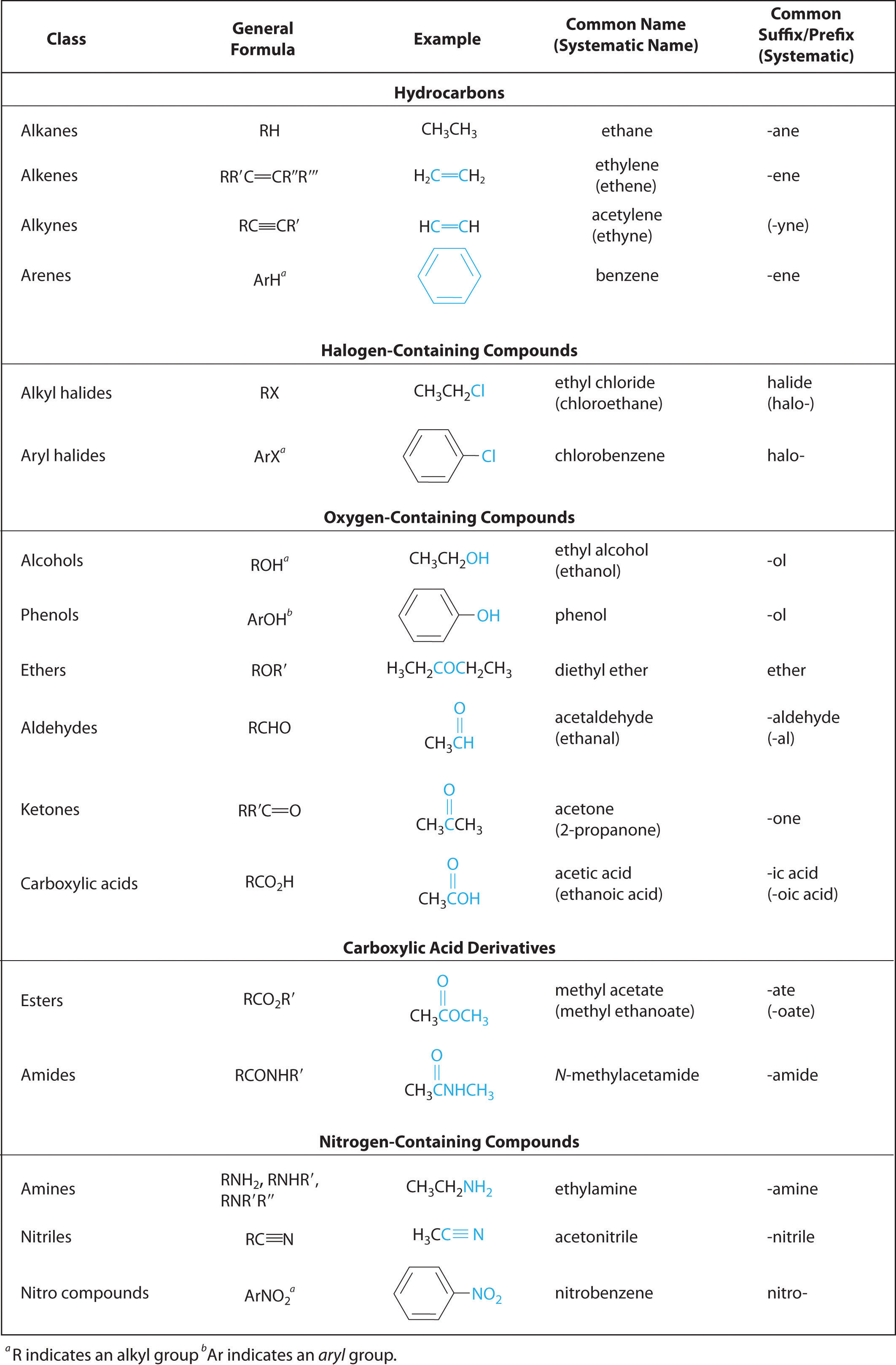
Table of Functional Groups
Once, we after we finish this side-track into Organic, the class will return to Modules Eight and Nine to see if the material makes more sense in the light of Organic.
Model Pix
Here is the plan. First, the kids are treated to an introduction to alkanes, the simplest organic molecules. I treat organic nomenclature in the same manner as inorganic nomenclature: hands-on. I do a brief introduction followed by examples, and show the kids several ways to represent structural molecules. Below are both a text and video introduction to Organic Chemistry.
Introduction to Organic Nomenclature
Next, the kids practice writing molecules.
Organic Nomenclature 10.4. 10.4 Key
Nomenclature Part 2 10.7. 10.7 Key
Once, they have an idea of how to write them, I have the kids use the models to build the molecules. Then, I repeat the process with alkenes, more practice, and more models. The key is to explain that organic chemistry is different branch of Chemistry. Most of the Apologia text is Inorganic Chemistry. Ironically, many applications involve Organic rather than Inorganic; yet, high school chemistry is largely Inorganic. Polymers are Organic. The molecular structures of chocolate and caffeine are Organic.
Table of Functional Groups
Once, we after we finish this side-track into Organic, the class will return to Modules Eight and Nine to see if the material makes more sense in the light of Organic.
Saturday, April 11, 2015
Apologia Chemistry: Acids and Bases
Once the kids have completed the household acid and base lab, I usually have them complete an acid-base series dilution with pH strips, using 1M HCl and 1 M NaOH. Once the dilution is prepared, the kids can measure the pH with strips, Universal indicator, or a pH probe. In an earlier post I explained that the TI 84 graphing calculator is preloaded with Easy Data software. Vernier sells a temperature probe which connects directly to the calculator. Vernier also has an adapter for the TI 84 which can connect a pH probe. I have shopped for used sensors on EBay and purchased them for around $40. A graphing calculator, temperature probe, and pH sensors are investment equipment for a Home-School Co-op. Outside of science labs, the kids can take the calculator and probes outside collect data, such as stream assays.
Apologia Chemistry: Acids and Bases
The Acids and Bases unit lends itself to a host of labs and activities. PhET has a good virtual lab.
One activity I always use is an acid base sort. I pull a bunch of household materials: baking soda, Epsom salts, vinegar, tums, lemon juice, clear soap, clear soda, apple juice, ammonia solution, table salt, etc. the kids use litmus paper and broad scale pH paper to determine whether the material is an acid or base. The solids must be dissolved in water before testing. I like the kids to create a data table with both the common names, chemical names, and chemical formulas to reinforce these skills. Here is what I mean by a table
Common Name. Chemical Name. Formula. Acid, Base, or Neutral
Baking Soda. Sodium bicarbonate. NaHCO3. Base
Apologia Chemistry Acids and Bases
This past week was consumed with family, cooking, and games! How good is God! Back to business. A unit on Acids and Bases is on the horizon. My friend, Teri, sent me this hysterical parody video to launch the unit.
Subscribe to:
Posts (Atom)
-
The class is completing their Designer Baby blogs. Finally. Yes,I sat on top of them in class. I still think the time investment is wort...
-
 The Co-op is reviewing for a series of cell quizzes and beginning with paper plate cell cycle models and mitosis with yarn. The first t...