Thursday, December 22, 2022

Rubber Band Engineer

 I read the How to make Books into Magical Gifts post from Six Figures Under.  In the blog, Stefanie mentioned the book, Rubber Band Engineer  (RBE).  I bought a used copy online to see if the projects would dovetail well for Science Camp.  It turns out there are several excellent projects for my husband, Rob’s, Physics class, too: Hydraulics.  There are five hydraulics projects.  Like the other projects, the hydraulics employ simple materials: plastic syringes, tubing, cardboard, cable ties, glue guns, masking and duct tape, craft sticks, paint stir sticks, and of course, rubber bands.  The projects are similar to this hydraulic-powered hand.  Rob does special projects with his Physics class the last few weeks of class and likes to add hydraulics activities.

RBE is perfect for Science Camp, too.  There are sections with catapults and rubber band-powered flight projects perfect for tweens, who like purposeful designs.  The materials are affordable.  Home Depot sells a ten pack of 12” paint sticks for $1.48 and bundles of wood shims for $1.58.  You might have craft sticks on hand already.  I buy them in bulk.  We’ll need to alert the Thrift Store at our church to scout for clothespins, craft sticks, and rubber bands.  Borrow the book from the library or order a used copy.  My copy is going to see hard use in Physics and at Science Camp, next June.


Wednesday, December 21, 2022

Chemistry on a Budget: Flame Tests!

 Yes, Flame Tests can be affordable.  Flame test kits come in two varieties: Safer Flame Test kits and Traditional Flame Test kits.  The safer flame test kits usually involve Colorful Flame birthday candles.  (BTW Walmart often stocks these candles in the Party section.). Beyond Benign has this flame test lab designed for colorful birthday candles, which cost around $3. 

 Here are instructions for doing flame tests with a tea candle. (You can test these salts on the gas stove, too.).  Use chloride salts. Here is the Flinn lab with wood splints (i.e. wooden coffee stir sticks).  Sodium chloride is table salt.  Calcium chloride is Driveway Heat.  Copper II sulfate may be substituted for copper II chloride.  Make up 1 M solutions with the salts and soak either wood splints, craft sticks, or Q-tips in the solution before lighting the stick or Q-tip.  Steve Spangler has these instructions for flame tests with boric acid and cream of tartar.  

You can mix the salts in hand sanitizer and light them with a match or butane lighter.  Here are the lab instructions.  Here is an image with the colors the flames produce.  Boric acid burns green, cream of tartar, potassium bitartrate burns a light purple or violet color, table salt, NaCl, orange, Driveway Heat, CaCl2, deeper orange, and copper II sulfate teal or blue-green.  The salt solutions produce slightly different colors.   You can calculate the energy emitted, too, with these instructions.  

My Co-op Chem class does a all of these lab activities.  I plan to use the colorful candles as the quiz.  We do calculate the energy—typically with some help.


Tuesday, December 20, 2022

Apologia Biology: Oreo Mitosis Lab!

 I just ran across these Oreo Cell Cycle and Oreo Mitosis and Meiosis labs.  This website has photos.  The lab requires Oreo sandwich cookies and colorful sprinkles.  My teens live candy and food labs they may eat after completing the lab.  This lab is pretty budget-friendly, too.  Usually, my Bio class uses yarn on construction paper to make mitosis and meiosis models.  Oreos are much more fun!  We may do both!


The Library of Things!

Our library system is located in a large DC suburb; it’s quite innovative.  There are  Maker Spaces with 3D printers, Make and Take kits, and even The Library of Things. Whenever possible I browse the local library for ideas.  Our local library has a dedicated shelf for its Library of Things.  Today, the shelf has crochet, bocce, a thermal detector, and air quality kit.  Next summer, I plan to borrow several kits for Science Camp.  I want to borrow the radon kit, thermal sensor, and air quality sensor.  Your library may have similar devices to loan.  Check and see!  If you want to borrow environmental devices, see if you have a NASA Outreach Center.  I’ve used the center in Katherine Johnson Center located in Fairmont WV.  These centers have an assortment of tools, such as GPS devices or IR thermometers to loan.  Check with the local Soil and Water Conservation District to see if there is an educator.  Usually, Soil and Water acts as a clearinghouse for resources from several agencies.  

Sunday, December 18, 2022

Science Camp: Books

 I’m researching ideas for Science Camp next June.  I came across to books in Six Figures Under post, Making ‘How to’ Books into Magical GiftsDuct Tape Engineer and Smithsonian Maker Lab.  I thought I had reviewed just about every science or maker book; I ordered used copies of both books. The Maker Lab book has a number of familiar ideas for Camp: kaleidoscope, water wheel, balloon rocket car, etc.  It isn’t breaking new ground; however, the photography and instructions are unusually clear.  I’ll have the kids browse and select five or six activities from the book for Camp.  The Duct Tape Engineer book is a winner.  I think the geodesic dome igloo, sling, hammock, and giant catapult sound fun.  The kids will be 12-13 next June; kids that age often  like practical, purposeful, projects.  Most of the projects, such as the geodesic dome rely on inexpensive materials: plastic sheeting, cardboard,  bamboo sticks, and duct tape.  I’m going look for deals on duct tape and break down boxes to stack and save.  I’m getting excited just thinking about Camp!

Monday, December 12, 2022

Science on a Budget: Great Christmas Gifts!

 Stephanie at Six Figures Under has a frugal gift idea.  She suggests pairing a maker book with needed supplies as a Christmas present.  Our family gives books as Christmas presents, too.  We buy them used or heavily discounted at Ollie’s, which often has maker books on sale.  The idea is to pair the book with the household items, such as a book about making marshmallow shooters with the PVC pipes, couplings, and marshmallow.  What a great Christmas present!

Family Science: STEM Kits

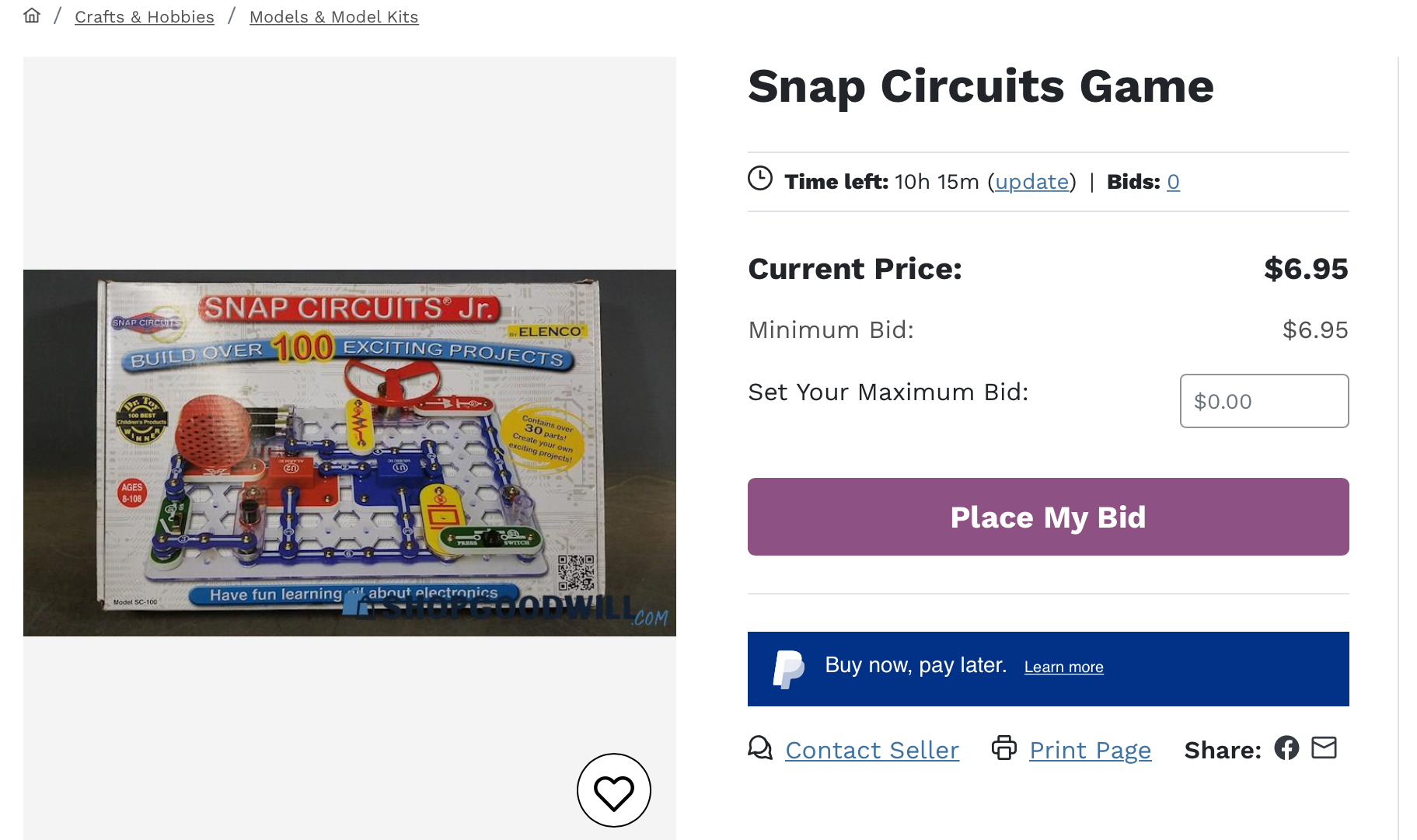
Our little family does a lot of science on the side.  Our son-in-law is a software engineer who loves to buy fancy kits.  Ken drops off Paul and the complicated kit for us to navigate. Have you considered buying a STEM kit for Christmas?   Good Will online has a LEGO BoostSnap Circuits, and Makey Makey kits available.  Makey Makey is a simple circuit kit.  However, this kit has clear instructions and fun ideas; kids use play doh and bananas to complete circuits.  LEGO Boost and LEGO Droid Commander are much more complicated.  First, the LEGO kits must be assembled. (You need to like building with LEGOS.  I mention this because our little family is NOT fond of building with LEGOS.) The controller needed to program the assembled robot can be tricky to insert.  (Ask me how I know.)  Our little family made the LEGO Boost kits family projects.  Programming the assembled robots was intuitive for Paul; but his daddy is a software engineer.  Paul was coding at seven.  I could understand the coding instructions from the LEGO Boost app.  I have no background or seemingly any aptitude for coding.  Look for sealed, used sets or kits.  Check at your library, too.  Ask if they have a Makey Makey kit, Snap Circuits, or other stem kits available.  Libraries with Maker Spaces often have these kits to try.  See if your kids even like Snap Circuits.  


Thursday, December 8, 2022

Types of Chemical Reactions Lab

 Next week, the kids are doing labs with different types of chemical reactions.  Years ago, a colleague gave me this lab with reactions.   The first reaction is between an iron nail https://www.homesciencetools.com/product/manganese-dioxide-15-g/ and copper II chloride solution, 1M concentration.  Copper II sulfate or  copper II nitrate work, too.   Home Science Tools does sell manganese dioxide for #2.  I use 3% hydrogen peroxide from Walmart or the drug store.  Reaction #3 calls for standard baking soda and glass test tubes.  BTW glass test tubes and beakers are best for these reactions. In reaction #4, PHTH is phenolphthalein, which is combined with calcium metal turnings.  Use one small piece of calcium metal.  Reaction #5 is between two or three cm of magnesium ribbon and 1M HCl.  For Reaction #6, you can use the same copper sulfate from reaction #1.  Don’t make a solution.  Instead heat it gently in a test tube.  We use Sterno and butane lighters to heat test tubes.  Reaction #7 is a precipitate reaction.   Look at the precipitate reactions listed below.  They are cheaper.  The last reaction, #8, is between copper metal and silver nitrate, which is expensive.  You may want to just add the reactions listed below.  Don’t apologize for sticking to a budget; I happen to have some silver nitrate and copper metal shot.  We save and reuse these metals year after year.

The kids are going to do these precipitate reactions, (Student Worksheet) with household chemicals, too.  Yes, I know these reactions are labeled as Middle School.  But, the reactions are excellent.  My kids do the reactions and then write, name the compounds and elements, predict the products, and balance the equations.  Incidentally, these are the reactions I use for the Stoichiometry test.  The kids have seen the reactions and perform better on their tests using familiar reactions.  Do as many reactions as you can afford.  

I made a slideshow using Jamboard with the balanced equations and types for lab #1.  N.B.  The equations are written with a stylus.  Below are photos.


Iron nail and copper II chloride


See the changes in the copper II chloride solution and on the nail after one hour.


We used 3% hydrogen peroxide and manganese IV oxide.  Be sure to use a glowing splint—not a burning splint.
This is the reaction between calcium metal turnings and distilled water.  DO NOT TEST WITH EITHER A GLOWING OR BURNING SPLINT!  


We heated the test tubes with sterno.

This is the test between magnesium metal and hydrochloric acid.  We use 1 M hydrochloric acid.  I
The middle test tube has silver nitrate and copper shot.


Chemistry on a Budget: Frugal Melted Plastic Cup Ornaments

 This is one of those science experiments the whole family can try. My friend, Dolores, sent me a TikTok video.  I thought, ‘Does this qualify as science?’  Maybe.  Craftulate has these instructions.  You need sharpie markers and plastic cups.  I decided to try #5 and #6 plastic cups; I had both on hand.  Look on the bottom of the cup; the numbers on plastic bottles or cups identify the type of plastic. You can do a ten second lesson with the kids and explain the plastic number codes—or not.   We’re replacing our range Tuesday.  It seemed like the perfect time to melt plastic in case the fumes are too strong.  As you can see, I invested a full minute coloring the plastic cups.  There really weren’t any fumes; it was like baking sculpey, clay models in the oven.  The results were uneven—but fun!  Next Thursday, we’re making ornaments in class.  I might add this one, too.  BTW, BOTH #5 and #6 cups melted.


Tuesday, December 6, 2022

Chemistry: Mole Lab: Percent Composition of a Hydrate

 After Christmas, we’re starting moles, using this lab series. One of the labs is call Percent Composition if a Hydrate.  Usually, we follow this Quick Lab. (Scroll through the chapter a bit.)  But the lab calls for a Bunsen burner to heat the chemical.  We substitute Sterno or tea candles; they aren’t as effective.  However, you can use aluminum weigh dishes on a hot plate, instead.  Thank you Facebook!  I’m using these lab instructions, substituting aluminum weigh dishes.  I’m going to try heavy duty aluminum foil I already have on hand, first.  I think we’ll compare heating copper II sulfate in a test tube and Sterno versus an aluminum foil dish on a hot plate to see which method removes the most water.  


Balance Equations with Bottle Caps—the sequel

 Today, only four kids needed to complete the White Powder lab.  Only two other kids had long since mastered balancing equations.  I had the two Joes make the instructional video for Experiment 5.1.  The rest of the class worked on using bottle caps to balance equations.  This exercise really helped the kids see that they often were doubling compounds.  They could literally count the atoms.  We are using these chemical equations to balance; there is a key. (#6 and #11 are the same.)  We practice identifying the types of reactions at the same time.  I took photos.  We used easier equations.  Some of the kids will need to use the bottle caps for awhile.


Film Canister Lab Challenge

 This Thursday is a holy day of obligation.  Instead of class, the kids are doing Experiment 5.1 and the Flinn Lab Challenge: Film Canister Rocket. We’re using the same constraints; the kids must get the film canister to launch at least one meter in less than two minutes.  I want film as evidence.  In the video, the kids must explain what they used to launch the canister.  They were also instructed to use only citric acid, baking soda, water, and alka-seltzer tablets.  Take a look!


Apologia Chemistry: Experiment 5.1 Measuring the Width of a Molecule

 Joe and Joe finished the video explaining Experiment 5.1, including the calculations.  The video the boys made is below.  Here is the slideshow with the calculations.


Monday, December 5, 2022

Balance Equations Resources

 My Co-op class has been balancing equations.  This post has four videos with my tricks to balance equations. Here are the PhET simulations for balancing equations.  Here is a worksheet to use with the introductory PhET.  See if these help.

Saturday, December 3, 2022

Chemistry: Teach Moles!

 I ran across this lab series.  I’m changing my approach to teaching moles.  Usually, I do many of these labs; however, I don’t teach them in a logical order to promote an understanding of moles.  My plan is to first introduce types of reactions in a lab.  Then we’ll launch into moles.  Look over the series.  Teens weigh moles, heat up hydrates, do Candium, etc.  We do Beanium—much cheaper.  I’ll post pix and notes when we reach the moles unit.


New Resource: Stoichiometry Decks!

 Take a look at Stoichiometry Decks.  Go to resources; there are three useful chart and a fun lab here.  Brennan, the author, has a blog, too!  Take a look.

Thursday, December 1, 2022

Set up a Science Lab

 What do you need to set up a science lab?  I’ve taught and conducted training sessions in a wide variety of spaces.  Right now, we meet in my unfinished basement.  We bought folding tables and chairs from Walmart.  I bought inexpensive whiteboards and metal shelves to store boxes of supplies.  I use hot plates to heat solutions.  We do have a large, utility sink for water or clean-up.  If the weather in your area is temperate, the garage is another suitable space.  One year, I taught Co-op from my house and did all of the labs in the garage.  You might cluster labs to do outside.  For example, I did the series of seven, animal dissections outside.  One time, the kids met at the park and we did dissections because the Church, where we met, did not allow wet labs.  When I taught Co-op Biology at the Church, we met in a religious education classroom.  I got inventive about labs; we did several water quality labs at the local streams.  We did many food related labs and activities, which were permitted.  We made loads of models and looked at tons of slides.  

Does your library have a Maker Space you can use?  Ideally, the space should have water, electric outlets, tables, and chairs.  But, you might use Sterno or tea candles to heat solutions if there are no outlets for a hot plate.  You can fill jugs of water and keep buckets or large yogurt containers for waste.  When I train, the seminar or workshop might be in a classroom, event space, or hotel room.  Naturally, the lab activities or discrepant events for a workshop are simpler.  But, I think having an open space is usually enough to do science labs.  I prefer a concrete floor; I don’t like to worry about spills staining floors.  Go take another look at your garage.  I bet it’s ideal for many labs.


Mad Science Camp: The Joy of Toys!

 Next June, I’m doing another week-long science camp.  We used many of my better science experiments at Science Camp last June.  Next June, one morning’s theme is the Joy of Toys.  We’re making toys with some science: Zoetropes, Kaleidoscopes, 3D Hologram, and Flipsticks, optical illusions.  I have a box of optical illusion supplies: Rubbing plates, Magic Eye books, Card deck, Mirascope, and Disappearing Beaker.  We use these supplies for Physics, Science Camp, and outreach programs.  (Here are instructions to make your own disappearing beaker.  See if the cooking oil you have on hand works before you buy canola oil.)  

We’ll make Take Home Stem kits, using Arvin’s Gupta’s Toys from Trash, including Flying Toys and this Ball shooter.  Speaking of shooters, Frugal Fun’s Marshmallow gun, made from PVC pipes is easy to build.  Cut the pipe ahead for younger kiddos.  Frugal Fun has a Scrap Wood Rubberband Shooter, too.  If you have scrap wood, make these Stomp Catapults.  (You may want to let them catapult balls instead of blocks of wood.) When I host Camp, I have the wood pre-cut to save time.  Borrow many hammers.  Scavenge extra PVC and scrap wood to make Balance Boards.  We have made simple balance boards with scrap wood, PVC pipe, or a length of a pool noodle.  The kids decorated their boards with washi tape.  If you feel brave, let the kids hydro-dip the boards—ideally outside.  Below is a photo from Camp when the kids made floppy disk boxes.  Are they really toys?  They were fun!  Start saving Pringles can, floppy disks, CDs, and scrap wood.


Apologia Chemistry: Experiment 5.1 Width of a Molecule

The three teens who are miles ahead of the class began Experiment 5.1, Measuring the Width of a Molecule.  Here is the slideshow I made when I taught Chemistry remotely during the COVID quarantine.    My Co-op class is finishing the White Powder lab.  A few kids were absent owing to illness.  I want to give them time to finish their labs.  Next week, the teens who have finished (most) are doing 5.1 or creating an instructional lab video. I’ll post the video when it’s complete.  The kids who were I’ll are going to do Experiment 5.1 at home or after class.  I take advantage of labs to work individually with kids, too.  After the kids finished the white powder lab, they started balancing equations independently.  I work with two or three teens to teach them my tricks.


Wednesday, November 30, 2022

Chemistry Christmas Ornaments and Labs

 It’s almost December!  Let the Christmas labs begin!  Make Borax Crystals with pipe cleaners.  Glitter pipe cleaners do not work as well as plain pipe cleaners.  Silver Holiday Ornaments is both tricky and pricey.  If you have your heart set on silvering glass ornaments, HST sells the chemicals needed for the lab.  Cheaper choices include Milk Plastic Ornaments, Stained Glass Glue Ornaments, Christmas Bulb Chromatography Ornaments, and Paper Atom Snowflakes.  The Poinsettia pH Indicator lab extracts the anthocyanin pigments to use as an indicator.  I plan to do Benzoic Acid Blizzard in a Bottle in December.  You can use the benzoic acid to make Snow globes.  Just hot glue a small object to the lid of a baby food jar.  One more quick idea from the HomeSchool Scientist, Fake Snow Experiments.  You’re welcome!

Chemistry of Popcorn!

 Three of my teens in the Chemistry Co-op class are miles ahead of their peers.  These three are going to do a couple labs and make instructional videos.  One of the labs we’re going to vet is the Gas Law Popcorn lab.  Here is another version.  I’m going to let the kids select the lab to use with the class.  Here and here are articles explaining the science of popcorn.  I want the kids to see how closely their results are to 14% water in the kernels.  One Chem teacher on Facebook suggests putting a layer of sand at the bottom of the Erlenmeyer flask before adding oil and popcorn.  We might try comparing results microwaving popcorn, too.  I’ll post the results.

Tuesday, November 29, 2022

Science Stuff at Hobby Lobby!

I didn’t know Hobby Lobby had science toys.  Next summer, we’re doing the Joy of Toys as part of Science Camp.  Right now, Hobby Lobby has free shipping for orders greater than $50.  Below are some science toys available.  Who knew?  Well, if you have a store near your house, you might already know.  My husband sets a limit of ten minutes in any craft store.   I don’t get to browse.


Test Tubes and Test Tube Racks

 I’ve been combing the web for science deals.  If you want a set of test tubes with a rack, I recommend buying a set.  HST explains the different test tube sizes, their volumes, and stopper sizes.  Buy a set instead.  Be sure the test tubes are Pyrex or borosilicate.  I haven’t found tremendous deals.  The set below from HST includes a test tube brush and test tube holder.  BTW, a plastic test tube rack might warp a bit with a hot test tube; most of the time there is little or no damage.  If you buy eScience kits used, often there is a cardboard test tube rack included in the kit.  They work fine for most labs, too.


Monday, November 28, 2022

Saturday, November 26, 2022

Chemistry on a Budget: Take Home Lab Challenges!

 Right now I’m hunting for ideas to use during science camp in June.  No, I don’t plan to clean pennies or combine Mentos and Diet Coke.  I stumbled across take home labs.  These labs tend to be safe; my science camp is composed of kids about ages 8-12.  Here is a long list from Terrific Science.  Look at Aspirin Tablets Can Differ,  Chromatography on Paper, and Sugar vs Salt.  These are sound chemistry experiments with safe, household chemicals.  The Homeschool Scientist has a long list of chemistry labs for different ages.  I’m thinking about adding some Food Chemistry, too: Curds and Whey, Food Cooking Chemistry, and Food Science Experiments for Kids from AtoZ Homeschooling.  I need to have a bunch of labs the kids can do at home with materials on hand in case we get a lot of snow this winter.  It helps to have a menu of labs; the kids can pick labs which require materials they already have.

Biology on a Budget: Water Quality Tests or Stream Study

 Are you doing a stream study in the spring?  Now is the time to buy aquarium test strips.  I like to use the test strips to measure pH, nitrate and nitrite levels.  Here are the basics for water quality study: pH, nitrates, turbidity, temperature, odor, and conductivity.  You could monitor a home well, tap water, or a stream.  You do NOT need expensive equipment.  Start with a thermometer, test strips, and a white ice cube tray, to sort macroinvertebrates, insect larvae in the water, which are water quality indicators.    Here is background information for sampling procedures, water temperature, water transparency, fresh water macroinvertebrates, and making a Secci disk to measure water transparency from GLOBE, sponsored in the U.S. by NASA.  You may like to add this cloud chart as part of the science of clouds.  Don’t worry if you aren’t exactly expert.  You and the kids can learn together.


Geocaching!

 In another life I used Garmin eTrex GPS devices to map sites for studies.  Families can geocache with these work horse devices.  But, you don’t need a GPS eTrex to geocache.  Instead download the free app on your cell phone to get started.  Here is an introduction to geocaching.  Look over this list of rules and geocaching etiquette before you start.  Sometimes, the cache has small prizes.  Here are ideas for small prizes to leave in exchange, such as keychains.  Does your family craft together?  Our little family likes to stamp leather keychains and bracelets, ideal as a small prize.  Try geocaching!  See if this fun activity resonates with your family.


Biology on a Budget: Step away from the microscopes!

 Amazon has a microscope and camera which connects to a laptop for $335.  It looks exciting!  In fact Amazon has several Cyber Monday deals for microscopes.  Step away!  Instead buy a USB microscope to connect to your laptop or Chromebook.  Buy a set of 25 slides from Amscope.  Have your teen focus the microscope slide with the digital microscope, take a screen-shot, sketch, and label the slide.  Repeat 25 times.  Job done.  All of your children can play with the microscope.  Look at paper currency, your skin, , etc.  Make the USB microscope a Christmas present.  See if you can beat the prices below for the microscope or the slides.  The set of four packs of  slides are fine for younger kids.  I have a set I use to teach kids how to focus the microscope because the objects mounted on the slides are larger.

BTW I don’t have my teens stain their own slides.  I never have any luck with the results.  My classes just study prepared slides.  They can make their own slides in college if they take Histology.


J


Apologia Chemistry: Phase Change Diagrams

Is it essential to teach about Phase Diagrams?  Probably not.  I do.  This slideshow has a video and video worksheet.  This CK Chemistry unit has videos and a simulation.  I use this worksheet (key) to help kids navigate a phase diagram.  Phase diagrams map the equilibrium states for a substance.  Stick to the phase diagrams for water and carbon dioxide.

I use this as an opportunity to explain equilibrium.  We live outside DC near Quantico.  I 95 is in our back yards.  I use I 95 to explain equilibria.  Monday to Friday, barring a holiday, I 95 North is bumper to bumper at 6 am; I 95 South is a small stream at 6 am.  At 6 pm, I 95  North is a small stream and I 95 South is bumper to bumper.  At noon, Monday to Friday, the traffic north and south on I 95 is roughly the same.  Traffic is in a steady state.  When I teach the module on equilibrium at the end of the course, I use the same analogy to show how to calculate the equilibrium constant.


Friday, November 25, 2022

Chemistry on a Budget: Molecule Kits

 Amazon has a huge discount on Happy Atoms, a magnetic, molecular modeling kit.  The kids build molecules and use an app to identify the molecule.  Hold off before you buy the kit.  I like molecule kits; there is a box of models in my basement classroom.  But, we use the kits to build specific models.  For example, when we introduce organic chemistry, the kids build models.  I use Lab-aids Molecules of Life kit.  I bought two sets—which were pricey.  However, I use them for both Biology and Chemistry, co-op classes.  Instead, make your own clay molecules.  Use the CPK Color Chart and tempera paint to color the atoms.  Use this chart to build molecules and check the bond angles.  I’m thinking about having the kids make their own molecule kits as a take-home lab.


Thursday, November 24, 2022

VSEPR Molecular Kit: Print with 3D Printer

 Does your local library have a 3D printer?  Check to see if there is a STEM lab or Maker Space at the library.  You can print models from the thingaverse, such as a VSEPR Molecule set.  (Here is a brief explanation about VSEPR  models.)  Browse the Thingaverse for different molecular shapes.  Frequently, the library will let you 3D print without any cost.  One caveat is the 3D printer can take a long time to print an object.  

Black Friday Deals

 There are some good Black Friday deals for science classes: pipettes, labware, molecule kits, pH paper, magnetic stirrer (no heat), and water gel beads. The prices for water gel beads vary.  I’m keeping a sharp eye out for deals in thermoplastic beads, benzoic acid, and stuff for science camp.  I’ll add as I find more deals.


Tuesday, November 22, 2022

Science on a Budget: Salt Dough Project Ideas

 Do you make salt dough for projects?  Here is a simple recipe from Celebrating Chemistry with suggestions to vary the flour and salt—making the dough activity more inquiry-based.  I recommend experimenting with several salt dough recipes.  What can you do with the dough?  Make cell models, landforms,  fossil casts, layers of the earth, and salt dough plants (Make the models scientifically correct.).  There was a suggestion on social media to use the corrugated campaign signs as bases for the salt dough projects.  Ha!  There are certainly many still up in our area since the election.  

Friday, November 18, 2022

Family Science: Test Sunscreens with UV Beads

 Do you have leftover sunscreen?  (BTW Sunscreen lasts at least three years.). Are you familiar with UV beads?  We string them on to chenille stems or pipe cleaners as simple bracelets.  When UV beads are exposed to sunshine or a black lamp, they change color.  Here are Steve Soangler’s instructions for testing sunscreens with UV beads. Here is an information sheet about UV beads.  Look for solar nail polish, too.  Your kids will have a blast!

Chemistry on a Budget: Kool-aid Labs

 This year’s National Chemistry Week was about fibers.  One lab resources was Dyeing to Color Fabric with Kool-aid.  Pull out old, white, cotton t-shirts to experiment. Read more about dyeing fabric at Dharma Trading.  Any dye adheres better to cotton with a mordant.  My teens also do this Koolaid Serial Dilution lab.  Here is a Kool-aid molarity lab.  When I teach unit conversions, the kids must make a five ounce cup of Kool-aid  Each kid gets a different flavor of Kool-aid; each type has a different mass.  The kids have to reduce the recipe for two quarts of Koolaid-aid to one five ounce serving.  Below is a video about the Kool-aid conversion lab.  We save leftover Kool-aid packs for the series dilution and dye labs.  Sticking to a budget doesn’t mean you can’t have fun or present your teen a challenge.


Thursday, November 17, 2022

Chemistry on a Budget

Update: If you use Benedict’s solution for the copper II reduction test, heat the powder and Benedict’s solution in a test tube in a boiling water bath.  We tried using boiling water from an electric kettle with mixed results.  When we return from Break, we’ll follow these instructions.  The Benedict’s solution produces results for sugars.  You won’t compromise your lab if you omit this test.  I had some on hand leftover from Biology class, last year.

The kids are starting the White Powder lab.  I’ve been dividing class time.  I squeezed in quick lessons on naming acids and balancing equations.  I start with a quick review lesson and then launch the lab.  Our Co-op classes meet twice a week for 90 minutes.  This lab usually takes a minimum of two hours to complete.  I use ten different powders; fewer powders would streamline the lab.  When I taught Chemistry remotely, the kids tested five powders and had one unknown.  Take a look!


This year I’m pulling up all the stops to get things organized. How?

 This year is going to be different! Ha! Who hasn’t said that?  But, I’ve implemented some changes.  I put together a series of lessons whic...