Friday, December 19, 2014

Science Fair: Experimental Design

The science fair project hinges on the experiment.  One of the Middle School students, T., wants to compare the burn rate of different types of wood: oak, birch, pine, etc.  My suggestion is to use calorimetry for comparison.  T. will need to make some preliminary tests.  How long does a small piece of wood burn?  T. will need to perform at least three trials for each type of wood tested.  He needs to burn wood chips to practically be able to repeat the trials.

T. also must locate a practical means to compare the burn rate for wood.  A fire pit outside has some drawbacks.  One, T. has to weigh the wood piece before and after the burn or measure the time it burns.  T. identified several, potentially confounding variables, such as wind speed and the outdoor temperature.  Burning wood inside reduces these two confounding variables.  T. might do his experiment in a fireplace and repeat each trial in the same location to reduce the number of confounding variables, things which can skew an experiment.

If T. uses the protocol for the soda can calorimeter, the controlled variables include the volume of water, the type of soda can, the mass of wood, the distance of the soda can above the wood, the type of thermometer, and the room temperature.  Confounding variables may include the soda can ,which is uninsulated, and the fact the wood burns in the open air, rather than in a closed container.  The simpler the design, the better!  The goal is to isolate one independent variable to test and to produce one dependent variable.  In this case, the type of wood determines the number of calories of heat.  (Calories, like joules or BTUs measure the energy content or heat value.). Each trail must be carefully recorded. T. must use 50 mL of water each time and the same mass of wood.  He should record the temperature of the water in the soda can before and after the burn.  The number of calories is determined by Q= m x c x change of temperature or Q, heat equals the mass of the wood x the Spcific heat of water (1 calorie /g degree Celcius) x the overall change in temperature, or the final temperature mupinus the initial temperature, the number of degrees the temperature rises.

Careful design, a minimum of three trials, and attention to detail all craft a good experiment.

Science Fair: Even More Updates

Our school is closing in on Science Fair, set for mid-January.   Now is the time for students to finish the experiments and write research papers.  My kids create slideshow presentations (Keynote, PowerPoint, Google Slides, etc) to help them get organized.  Slideshows allow students to edit, save citations, and make creative changes.  Kids can use templates for the slides and then print them for their display boards.

The content in the research paper is key.  The student should have a complete understanding of the topic.  One of the Middle School students is comparing heat values of different woods.  T. must understand combustion, BTUs, calories, joules, cellulose, hard wood versus soft woods, and the principles of calorimetry.  Students should start by defining every unfamiliar term they encounter as they research.  Next, kids should look up all the formulas and have images or graphics for each molecule or compound.  In this case, wood is composed of cellulose; what is its molecular composition?  It is important to keep track of sources.  One way is to copy and paste links into the Bibliography page in the slideshow or book mark specific pages.  The science textbook may have information; kids tend to overlook this resource.

As students perform the experiment, keep track with photos, creating a photo journal, which includes the materials, observations, changes, etc. T. can assemble a simple calorimetry experiment with a soda can and platform to burn the wood. (Soda Can Calorimeter).   He should photograph every experiment and print a few images for his display.  T. can bring this equipment to the Science Fair as part of the display.  (Chemicals, liquids, and glass are prohibited.).   This brings up another aspect of the research paper.  The student must be able to name every part of the experiment, identify the independent, dependent, controlled and confounding variables, explain the process, discuss the outcomes, and draw conclusions.

With this level of detail and consideration it is time to get a move on!

Monday, December 15, 2014

Science Fair: Research Paper

Where to start?  First, ask the standard questions: who, what, when, where, and why.  Let's look at one project on cell phone radiation.  The student must be well versed on the topic.  What is cell phone radiation?  What is an EMF?  How is it measured?  Why do cell phones emit radiation?  Do land lines emit radiation?  Do cell phones cause cancer?  Is there any research?  Do studies indicate cell phones do or do not cause cancer?  This part of the process is called the literature review.  As the students gleans information relevant to the topic, he or she becomes familiar with issues or the science related to his or her project.

Once the student has some background, this constitutes the first part of the research paper and becomes part of the introduction.  The introduction should include information about the topic?  What is cell phone radiation?  Is it harmful?  What do studies indicate?  The research paper does not have to be lengthy.  The introduction should be at least one paragraph with three to five sentences.  Ask your child to tell you about his or her project and then type up these answers.  Once the student has the thoughts written, it is time for revisions.  Unlike this blog, the paper should be written in the third person, present tense, and active voice.  For example, 'Cell phones emit radiation and the amount of radiation varies.'

Each section of the research paper should be written as paragraphs.  Students may title each paragraph.  See this example.
Materials:
The materials for this experiments include the following: an EMF detector, thirty different cell phones, a field notebook, and a pencil.

Procedures:
The first step in this experiment is to remove any case and to place the cell phone face down on a solid surface.  The next step is to measure EMFs from each cell phone with the detector both 'on' and 'off'.

These sections need not be long-just complete.  Often the entire paper is only two pages.  Judges do want to see the research paper.

Friday, December 12, 2014

Science Fair: Update

All Science Classes
So far, most of the kids have their hypotheses and are researching their projects.  Now is the time to gear up and get moving on the experiments!  The first step is to see if your child is using an idea from a web site, such as sciencebuddies.com; if so, check there for materials and procedures.  If the child has a more original idea, try a web search for materials and procedures.  Often, there are two or three common methods; encourage your child to do some preliminary experiments to see which method produces the best results.  Be sure to take photos as documentation!  Keep a log or field notebook.  However, photos with time and date stamps or videos can comprise an electronic notebook.  In fact, the student may want to create an electronic folder for science fair files.  I encourage kids to use their cell phones to text themselves reminders, notes, and photos.  My kids create slideshow presentations and add slides with references and photos to keep the information together.  It makes things much easier to edit and print for their displays.  The kids can bring laptops and tablets to the Science Fair should they need to consult their notes.  One last tip is to download reference material as pdf files on their computers or tablets.  This way the child will have that reference to work with off line, especially when Internet access is an issue or the wifi is spotty.  The student can consult the references in their electronic file at the Science Fair, too.

Wednesday, December 10, 2014

Science Fair: More on Hypotheses

Let's use the cell phone radiation experiment to help hone the null and alternative hypotheses.  P. And M. are using an inexpensive cell phone EMF meter to measure cell phone radiation.  Their null hypothesis for this experiment is "All cell phones emit the same amount of radiation." Their alternative hypothesis is "Apple cell phone or iPhones emit more radiation than Android cell phones."

Their alternative hypothesis could just as well have been that Android devices emit more radiation than Apple phones.  What happens if all of the cell phones do emit the same amount of data, is their experiment a failure?  No!  Their results may support either the null hypothesis or the alternative hypothesis.  The data may in fact, refute both!  The important thing is to have an idea to test which becomes the hypothesis!

Science Fair Experimentation

One of the biggest misconceptions kids have about their projects is that unless everything goes perfectly, it has failed.  This morning, some of the kids started to collect data for their experiments.  L. and D. had the idea to build batteries, a fine exoeriement for middle school aged students.  They had an experiment from Apologia's Middle School Chemistry and Physics textbook. L. had also performed several electrical experiments in stations last summer at Science Camp, including Squishy Circuits.  L. and D. spent several hours mixing the playdough, sanding pennies, and building circuits with LED bulbs.  They used lemon juice, coffee, potatoes, battery packs, etc.  After an entire morning experimenting, they cheerfully abandoned the project and changed direction altogether because they could not get the experiment to perform according to their expectations, after doing some great science!

Students have trouble seeing that the trial and error, redesign, and frustrations are at the heart of the scientific method. In fact, it makes for good discussion during the child's presentation. I am partially to blame; I select experiments which deliver good results to avoid some of this frustration and angst associated when an experiment does not work well.

L. and D. switched to testing the pH of saliva.  They spent the rest of the morning saturating pieces of water color paper in universal indicator, and drying the paper with a hair dryer.  The two calibrated the paper with lemon juice using the pH color scale in the Apologia textbook.  They will compare their strips with commercial strips.  The two left armed to collect data.  L. and D. Took five minutes, decided how long to leave the strip in a person's mouth, and which questions to ask their participants.

Another pair of students, P. and M. are using an inexpensive cell phone radiation meter to collect data.  They spent the morning doing preliminary testing: type of cell phone, with or without the case, upside down or face up, on or off, texting, playing music, sending or receiving a call, etc.  they were getting mixed data and retested using different sensitivities on the meter.  M. was a little frustrated because the project was open-ended.  The pair tested everyone's cell phones, the land line, the TV, and three old iPods.  I sent them home frustrated with instructions to research EMFs and cell phone radiation.  Do different devices emit varying amount of radiation?  Is the radiation dangerous?  If so, how is it dangerous?  Even if the data from the meter varies, they have a tremendous amount of information to consider as they conduct their project, continue to research the topic and collect more data.


Tuesday, December 9, 2014

WA Science Fair Update

WA: Science Fair Updates
Science Fair is January 13, 2015.
Today students received hard copies of the score sheet, the research paper outline, an article on essays, a set of headers, a sample display guide, and a sample judge's form.  Please check the Blog and Google Classroom for more information.  As students complete any of the components, they should email updates to me for review.   Mrs. Howett will review any essays, too. 

Science Fair Organization

Students struggle to organize their science fair projects.  After all, the process can be daunting, especially for the uninitiated.  This  Presentation may help.  I encourage my classes to start by creating a slideshow presentation which includes the major components of the project.  Some documents, such as the hypothesis or abstract, appear in the research paper and on the display board. The idea is to use the presentation as a notepad to rough in the project to make it easier to edit.  The slide backgrounds and fonts can be adjusted and printed to be used on the display board.  The student can often bring the laptop or tablet to the Science Fair competition to show the judges.

There are a number of free presentation apps, such as Prezi or Google Slides.  The 'Slides' app for iPad is rough and difficult to edit.  I uploaded the presentation I had first created on my iPad and reopened it on my Dell laptop; this slide app is limited in its choice of themes.  There are excellent templates available in Google docs, you may wish to use instead.

Monday, December 8, 2014

Science Fair: What do judges ask?

Every school district, county, and state have their own scoring guide for judges to use to evaluate science fair projects.  Sometimes the judges work in teams, sometimes alone.  The forms tend to be vague.  Creativity?  Just how is that defined?  That aside, the judge will see if the project has a hypothesis, a research paper, an experiment, data, methods, materials, and a conclusion.  Most of the time, when I judge, I ask the student or team to tell me about their project.  Many kids have memorized a script.  I prefer the kid to just start explaining what he or she did, how it turned out, why they selected this project, what happened that was unexpected, or what he or she might do differently next time.  Why did you enjoy this experiement?  What does the data imply?  Did the data support or refute the hypothesis?


Example One
Example Two

Science Fair: Display Backboard


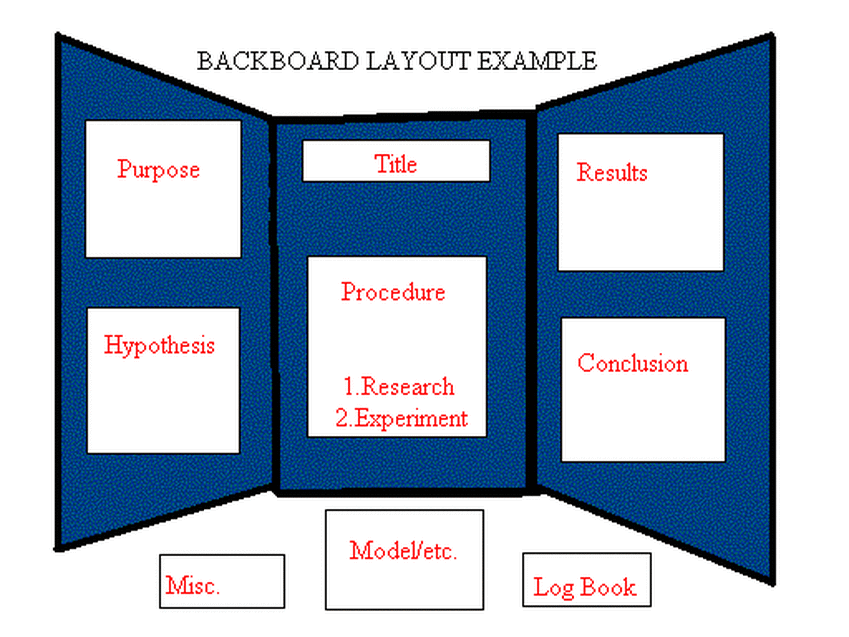
Intel Display Guide is a 45 page presentation explaining how to prepare a display-certainly a very useful presentation if your project makes in to International!  If you look at images of displays, you will notice that there is no consensus as to just what must be on the display.  This Backboard Display example is typical.  The trifold display backboards sold at Walmart or at an office supply store are fine.  Shop around!  Don't spend $12 on a backboard!  Try to locate one for under $5.00.  It is not necessary to buy the tags which say 'Methods' or 'Hypothesis', often called 'headers'.  Just type and print them.  Be sure to have color!  Include photos of the experiment.  Bring a model or any equipment used. (Leave chemicals and glassware at home.) A simple white backboard with construction paper and neatly printed information is fine.  The judges are considering the merits of the project, not the amount of glitter glue or creative use of foam core.  This Display Example has excellent color graphics, typed information, all neatly presented.  The content is more important than its presentation as long as the content is scientifically accurate and the information is well understood by the student.

Science Fair: Title Page

Here is a title page to introduce the research paper.  Some fairs request that the student remove his or her name.   Be sure to check the local guidelines.

Nitrates in the Mill Creek watershed


Nitrates in Mill Creek
Deborah Stevens
Musselman High School


Correspondense regarding this report should be directed to Deborah Stevnens
Chemistry Teacher
Musselman High School
126 Excellence Way
Inwood WV 25428

Science Fair: Research Paper Example

Here is an example of a research paper so students can get an idea of the style required for competition.

  Research Paper Body

Introduction

The null hypothesis for this experiment is that the nitrate levels in Mill Creek (at the public access point tested) will not exceed the safe drinking water standards during the thirty day test period.  The alternative hypothesis for this experiment is that the nitrate levels in Mill Creek (at the public access point tested) will exceed the safe drinking water standards during the thirty day test period.  Nitrates (NO3-) originate in fertilizers, sewage, run-off from farms and residences, faulty septic tanks, and erosion from natural nitrate sources.  Natural water sources contain typically less than one ppm (mg/L) of nitrate/nitrogen (the form measured according to the Environmental Protection Agency (EPA) Clean Water Standards).  The EPA posts “maximum contaminant levels” (MCLs) which include standards for microorganisms, disinfectants, disinfection byproducts, inorganic and organic chemicals, and radionuclides; nitrates are classified as inorganic chemicals.  Nitrate levels in drinking water that exceed 10 mg/L can cause methemoglobinemia or “blue baby syndrome”; infants younger than six months of age are susceptible through contaminated water in bottles or water mixed with baby formula.  The reason young infants are susceptible to “blue baby syndrome” is because their stomach acid is as concentrated as older children and adults.  Bacteria can form in young infants’ stomachs that converts nitrates to nitrites (NO2-), which can be absorbed in the bloodstream, oxidizes iron in the hemoglobin of red blood cells, and forms “methemoglobin.”  Methemogloboinemia describes the condition of a baby with elevated levels of methemoglobin and is potentially fatal; infants may be treated with methylene blue solutions.  Consequently, it is important to monitor nitrate levels in water.

Natural water sources usually contain less than 1mg/L (1ppm) concentration of nitrates and are limited as a resource.  Nitrates are part of the nitrogen cycle and an essential plant nutrient.  In a natural, healthy ecosystem, excessive nitrate levels are seldom a problem.  However, farms, faulty septic systems, and residential neighborhoods can contribute to excessive nutrient run-off into neighboring water systems.  The Chesapeake Bay watershed implicate excessive nutrient run-off (particularly nitrate and phosphate nutrients) as the chief problems  currently confronting the Bay.

Science Fair: Abstract

Here is an example of an abstract.

The Effects of Nitrates on the Mill Creek Watershed

Abstract

Nitrate in Water examines the effect of excess nitrate nutrients in a local stream, Mill Creek, at a public access area in Bunker Hill, Westy Virginia.  The study measures the nitrate levels in the stream over a thirty day period using standard LaMotte test procedures.

Science Fair: Research Paper

Research Paper Outline
Title Page
Name of the Project
Teacher's Name
Centered on letter-sized paper

Abstract
Summary of the Project

My students often struggle to write a research paper.  Here is an outline.  One tip which can help is to begin with presentation slides for each item, beginning with the title.  Students can print the slideshow for their display board.

Research Paper
1. Abstract
2. Introduction
  – Literature review (What is an alcohol rocket car?)
  – Independent Variable
  – Dependent Variable(s )
  – Controlled Variable(s)
  – Confounding Variable(s)
  – Purpose
  – Rationale (Why?)  
  – Hypothesis  
3. Materials
4. Methods or Procedures
5. Results (Data, chart, table, or graph)
6. Discussion
   – Did the experimental data support or refute the hypothesis?
   – Describe the mean, median, and mode.
   – Describe the variance and standard deviation.
7. Conclusion
   – This section explains the findings or what happened.  Did anything unexpected happen?
   – How did your experimental results compare to other researchers'?
   – Can you offer an explanation for the results?
   – Is more study recommended or indicated? (More study is indicated.)
   – Offer ways to improve the experiment next time.
8. Bibliography (Ideally conforming to MLA style)

Science Fair: Step One

Where to begin?  Begin with an idea.  Start with Science Buddies, a terrific site with thousands of ideas.  Once the idea is fixed, it is time to write a hypothesis.  There should be two parts: the null hypothesis and the alternative hypothesis.  Here is an example.


Hypothesis

The null hypothesis for this experiment is that the  average nitrate levels in Mill Creek (at the public access point in Bunker Hill) will not contain exceed safe drinking water standards during the thirty day period of water testing.

The alternative hypothesis for this experiment is that the average nitrate levels in Mill Creek (at the public access point in Bunker Hill) will contain nitrate levels that do    exceed safe drinking water standards during the thirty day period of water testing.

Thursday, December 4, 2014

Apologia Chemistry and Physical Science Labpaqs

One issue Homeschool co-ops and families encounter is access to chemicals.  Home Science Tools is an excellent resource for small quantities of chemicals.  I order materials from Amazon or buy household chemicals at Walmart.  When I worked at a small, private school, there was little in the way of materials.  I learned that the local pharmacy or grocery store had many common chemicals at vastly reduced prices.  I have used household chemicals in labs ever since.  So, how does one determine their formulas?  Some household chemicals, such as Epsom salts, have the formula on the package.  The Illustrated Guide to Household Chemistry has a table of easy to assess chemicals along with fairly complex labs, which have been professionally reviewed.

I accidentally ran across Labpaqs on Shop Good Will, under the heading of small scale labs or lab kits.  I did some research and several colleges and programs use custom kits for distant learning.  The Labpaq kits have goggles and a surprising number of sophisticated materials.  This type of convenience comes at a price; I got a set on Ebay for much less than retail.

In any case, all of the materials our classes have used, with the exception of some vials and test tubes which were donated, originate from Home Science Tools, Amazon, Walmart, or a Labpaq.  We set up lab stations in the garage where the ventilation is good-but, the lighting could use a boost.  I want to encourage the use of small scale labs whenever possible.  Collect cassette cases to hold test-tubes and purchase reaction plates, which only hold small volumes.  We use craft sticks, toothpicks and disposable pipers and toss them to reduce cross contamination.  Small scale labs allow the kids to repeat experiments several times without extra costs or hazards, too.

Apologia Chemistry and Physical Science

The Chemistry class is in the midst of moles.  Two weeks ago they did a lab in which they prepared a series of 1M (one molar or one mole per liter) solutions for the Physical Science class' precipitate lab while the Physical Science class used Flinn's Putting the Ions in Their Hands activity, previously mentioned in earlier blog pages.  Yesterday, the Chemistry kids prepared more solutions for the Physical Science kids.  One of the students had been absent two weeks ago and I wanted him to have this experience.  Besides, two weeks is a long time to remember a relatively new skill; I decided it would be good for them to prepare some more solutions.  The Chem kids made 1M solutions of copper II sulfate, magnesium sulfate (Epson salts), sodium chloride (table salt), potassium chloride (fake table salt), calcium chloride (Driveway Heat), and silver nitrate.  I have small 50 mL vials which were donated.  The kids have to calculate the respective molar masses and then combine 0.1 moles in a total of 100 mL.  The key is to combine the salt with about 50 mL of water in a flask and then add water to make a total of 100 mL of solution.  If the kids measure a volume of 100 mL of water and then add the salt, the total concentration won't be 1 M.  The kids ran into a hitch when they learned there wasn't enough silver nitrate powder to prepare a total of 100 mL and had to set up a proportion to determine how much total volume they could prepare with the amount of silver nitrate they had on hand.  See why I like this lab activity?

Meanwhile, the Physical Science kids were reviewing nomenclature.  Last week, they had used similar solutions to observe precipitates.  This week, I had the kids write the names of the compounds formed when they observed a change.  I added a wrinkle.  We wrote calcium or sulfate instead of
Ca +2or SO4 -2 on the vials.  The kids had to look on their ion charts to determine if the species was a cation or anion.  They were instructed to combine cations with anions.  After they combined the ions, they wrote the names and formulas for the combinations that reacted or changed.  The kids had the idea to write the names on craft sticks next to the reaction plates.

Just as a note, I have been bidding on Labpaq kits on Ebay and Shop Goodwill.  One of the Labpaq kits, LP2598- CK 01 had lead nitrate, extra reaction plates and a small digital scale.  I had purchased
another scale previously.  This one is a fraction of the price.  More on Labpaqs in the next post.

Apologia Chemistry and Physical Science

Here are some photos of the lab.  The next post will explain the set-up and purpose.

Wednesday, December 3, 2014

Science Fair Resources: The Sequel

Science Fair 2015
I like Science Fair: judging, coaching, seeing the final projects, the whole process.  I am the exception.  The reason I promote Science Fair is that it embodies so many of the skills valued by employers and espoused by Common Core standards: public speaking, technical writing, research skills, working as a team, completing a project!  I think every student should do this once.  Here are some steps to getting started.
1.  Start by looking at the local science fair guidelines. Here are the Berkeley County, WV  High School Guidelines and Middle School Guidelines.
2.  Most regional science fair expos follow the Intel rules and use their forms.
3. Once you are familiar with the rules chose a project; try starting with Science Buddies.  Their web site has great suggestions.  Students often ask if using a published idea is cheating.  In science, any experiment must be replicable; so, using a science project idea is fine.  Just don't copy a research paper and be sure to cite the project in your bibliography or work cited page.
4. Once you have an idea, write the hypothesis, which should contain both the null hypothesis and the alternate hypothesis.  Null and Alternative Hypotheses set up the data for statistical analysis.
5. Next is the experiment.  What are you testing?  What are the independent and dependent variables?  Identify the controlled or confounding variable. This you-tube video reviews Types of Variables.
6. The student should design and implement his or her experiment with a minimum of three trials.  It is important to keep good records, take pictures, write notes, date experiments, and jot down sources for the experiment.  Include pictures of the equipment, the student doing the experiment, and results, whenever possible.  This is a good way to document the project.
7.  The research paper can be daunting.  Research paper outline and Research paper sample may help.
8.  Once the experiment has been completed and analyzed, the report written, it is time to assemble the Project Display Board.  Here are some Headers or Headings.  Be sure to add photos and avoid pictures of faces, which may or may not be allowed.  Come up with a colorful title and interesting question.
9.  Usually, an abstract or brief summary of the project should be included with the forms and research paper.  A copy of the abstract may be placed on the display board.
10.  Judging at the Science Fair is easy if the student has done all of this work! When I judge Science Fair projects, I ask kids to tell me about their projects.  The student should think about why he or she selected this project.  Does it have implications for society, like a project on texting?  Did anything surprising happen?  What obstacles were encountered?  What would you do differently next time?  Students may memorize a speech; but, the best presentations are delivered by students invested in their projects.

Wednesday, November 26, 2014

Watershed Dynamics: Overview

I am exploring the Google Classroom available through our School, Winchester Academy.  Next week, we have a special program scheduled on Tuesday to introduce the project.  On Tuesday, the students in grades 6-12 will take part in a series of workshops, activities, and training modules.  I am borrowing an Enviroscape model to introduce the watershed concept, doing Color Me A Watershed, inviting guest speakers, looking at Musselman High's former watershed program, The Incredible Journey, Bingo, activities at Cacapon Institute's Potomac Highlands eschool, and graphing exercises.

Okay, Tuesday's half-day workshop went pretty well.  The speakers could not come; we had plenty of activities and my son was home to help.  I planned about five hours of activities.  The kids created Paper Bag watersheds before we reviewed watershed principles with the Enviroscape model.  We borrowed our model.  Many conservation districts have access and will come out and do a presentation.  The conservation districts offer sponsor Envirothon, a competition in which teams of student test their knowledge of soils, wildlife, water quality, etc.  The conservation district's education representative can make a pitch.  Some districts can deliver presentations with a groundwater model or a lesson on soil assessment.  Both make excellent activities during a watershed program.  We used several ideas fro Project Wet and still need to go over National Geographic's Fieldscope program, GLOBE, GIS, IHMC, and Cacapon.

One thing we did do was have the kids set up their  Science Bingo boards and play bingo at the end of the morning.  I wrote twenty-five terms related to Watersheds on the board: load, riparian buffer, EPA, GIS, Field Scope, NOAA, impervious surface, point, non point, Cacapon, watershed, fence out streams, winter cover, macro invertebrates, rain garden, bioswale, rain barrels, runoff, any related terms.  Be sure to have the kids write their terms in different orders on their bingo boards.  We played several versions: Letter H for high school, four corners, postage stamp, to vary the game.

Thursday, November 20, 2014

WA: Life Science

Next week, the Life, Physical, and Earth Science classes will have a special program on Watershed Dynamics, Tuesday, from 9:00-12:30.

Life Science:  This week, Life Science students completed a diffusion lab, several graphing exercises, some data analysis, CER, and a POGIL Prokaryotes and Eukaryotes activity. The goal is to finish Cell Processes and start DNA and Genetics.  CER is Claim-evidence-reasoning activities to build critical thinking skills.  POGIL is a guided inquiry exercise which develops analytical skills.  The class is becoming more adept with the graphing calculators.  The kids did a Data Analysis and Graphing Predator-Prey Interactions.  Just a gentle reminder that students need to devise an experiment for their Science Fair projects.  The class is making excellent progress!


WA: Earth Science Weather Project Guidelines

Weather Project:
Weather topics: barometric pressure, wind, precipitation, temperature, humidity, clouds, and weather stations or charts.
Lesson: 
1. Brief background of the topic in slideshow
2. Sample Instrument
3. Explanation of how it works
4. Time to make and field test the instruments
5. Wrap up

Slideshow: Prezi, PowerPoint, or other presentation software
1. Scientifically accurate
2. Grammatically correct
3. Ten slides minimum 
4. Has an explanation of the process
5. Contains background information
6. Order: 
   a.  Title
   b.  Background
   c.  Explanation
   d.  Instruments pictures (different types, such as analog or digital types)
   e.  Graphics, pictures, images, or videos
   f.   Bibliography or Work Cited in MLA format

Instrument:
1. All materials for the class
2. Example pre-made and class tested
3. Classroom demonstration and dry-run
4. 10 sets of materials
5.  Date of demonstration

Wednesday, November 19, 2014

Apologia: Chemistry, Can You Make 2 Grams?

The next class after Thanksgiving Break next week, the kids are going to combine several concepts and do Flinn Scientific's Can You Make 2 Grams? lab.  Go to the end of the lab document to see the different combinations of chemicals to find some familiar compounds: magnesium sulfate hepta hydrate and calcium chloride dihydrate.  I have calcium acetate and potassium chloride from another lab.  Sodium carbonate is also called washing soda.  The goal for this lab is to combine the correct proportions to yield two grams of a precipitate.  The kids must take the two chemicals, write their respective formulas, predict the products, identify the precipitate, balance the equation, and work backwards to determine how much of each reactant is necessary to make a theoretical yield of two grams of the precipitate.  This is a great lab for a formal report, one of two required by Mother of Divine Grace.  The lab report should have a title, background information about moles, solubility, precipitates, and stoichiometry-all correctly cited using either MLA or Turabian standards.  The report should include the materials used, the methods or lab instructions paraphrased, the balanced chemical equation, the data, or amount of precipitate in the yield, a discussion with possible sources of error, and a conclusion.  The reason I like to have kids use this lab for a formal, written report is that they hate this lab and hate writing formal lab reports.  Why bias them against Chemistry?  I would rather they just despise one aspect of Chemistry.  This is one of my favorite labs.  Not the kids'.

Apologia: Chemistry Moles

The Chemistry class began today's lesson with a mole activity.  They are working on the POGIL  ChemActivity 27. (Here is the Mole ChemActivity 27 Answer Key) over the Thanksgiving Break.

Today, I had the kids weigh moles, first.  Sounds stupid, right?  It helps!  I had the kids calculate the molar mass for copper (II) sulfate penta hydrate, magnesium sulfate hepta hydrate, sodium bicarbonate, water, and salt.  You can give them just the formulas or names to add a little nomenclature.  Once they calculated their respective molar masses and weighed the chemicals, the kids made 1M or one molar solutions of each compound.  I did not want liters of each solution.  Instead the class made 1 M solutions by dissolving 0.1 moles of each compound in 100 mL of water.  (If you have your class make solutions, be sure to explain they need to dissolve the salts in about 50 mL of water and then add enough water to make 100 mL total.  If they add the salts to the 100 mL of water, the solution will not be exactly 1M.). The Physical Science class used these solutions for their precipitate lab.  We also spent time reviewing last week's hydrate lab and the lab on metal reactivity.  I had the kids calculate the theoretical yields for each hydrate before determining their experimental yields.  Once they had both calculations, they determined the percent error.  The error was high because they had not heated their hydrates long enough to remove the water from the compound.  The Percent Composition of Labs is quite similar to  Mini-lab Percent Composition we used.  The kids used 5-10 grams of Epsom salt and copper (II) sulfate hydrates last week.  They heated them using test tubes and an alcohol burner.  They should have heated the salts longer. Lastly, we practiced balancing equations, especially combustion equations and those with polyatomic ions.  Balance Equations with Polyatomic Ions


Apologia: Physical Science Chemistry Lesson

Apart from learning how to write formulas, the group did some more exercises on the graphing calculator, including how to create a histogram.  Wild About Math has several exercises with instructions and calculator screen shots.  The class did another lab, this one Precipitates.  I am using Middle School Chemistry produced by the American Chemical Society (ACS) which has 5E lessons, demonstrations, and labs.  These ACS activites are safe, well tested, and typically involve household chemicals.  The activites include answer keys and detailed background materials.  Perfect for home-school families!  This lesson, Precipitate Lesson has sources for materials, explanations-even scripted questions.  This lab is a great way to introduce kids to observations regarding chemical change.

Apologia: Physicsl Science Chemistry Intro.

The Physical Science class officially begsn a chemistry unit with inorganic ionic nomenclature, Flinn Scientific's Putting the Ions in Their Hands.  The kit I purchased through Flinn came with the ions printed on red and blue card stock.  So, I copy the cations or positive ion sheet on red card stock and the anions, negative ions, on blue card stock.  I usually draw a red cat with a big plus sign and a blue ant with a large negative sign to help kids remember how to differentiate between cations and anions.
IonicFormula Writing Video is a brief video of the activity.

Monday, November 17, 2014

SOAR: STEM Grant

I am planning some grant proposals for SOAR, a comprehensive grant program for Winchester Academy, and am trying to devise ways to infuse our curriculum with more technology, engineering, and valid applications.  Moreover, these ideas should be part of a project and take place on campus to make the program relevant to the whole school.  I think we will start with the GLOBE Watershed Dyanmics project.  I took part  in the West Virginia Watershed Dynamics project a few years ago.  The program employs GIS, mapping tools, data collection with sensors, and several valid lessons and activities which are part of a comprehensive unit in Modukes.  Many of the technology tools are free and available online.  This week my Earh Science class will become acquainted with these tools, training modules, and learning activities before beginning the Watershed Dynamics project. Long experience indicates that it is best to introduce the tools to students before starting the program itself.

The Watershed Dynamics programs uses mapping tools; IHMC has free concept mapping tools, Cmaps.  A concept maps helps students understand the relationships among terms or ideas embedded in a lesson or unit.  I am a reluctant convert to concept maps; they are useful to students as an assessment tool to gauge their understanding of a given concept.

The next tool is National Geographic's Fieldscope, a GIS program.  The first step is to watch the tutorial introducing GIS program.  Once they are familiar with the idea of GIS and how Fieldscope works, the class can take time to learn about GLOBE's Training Modules, which dovetail with the Watershed Dynamics project.  On to Cacapon!

Cacapon Institute's e-school has extensive training on watersheds.  The kids will begin with the slideshows and games before scanning the site's resources, especially, the virtual streams.  The last resource to explore Explorer for ArcGIS, am online mapping tool similar to Fieldscope.

Friday, November 14, 2014

POGIL: Process Oriented Guided Inquiry Learning

POGIL is an effective way to teach science.  I have used it intermittently with my Chemistry classes.  Some colleges use this approach to supplement lectures or replace lectures.  This approach can be effective for AP classes in high school.  I first encountered POGIL at an AP Chemistry workshop and have used several exercises successfully in college-bound chemistry classes.  This approach takes time-both to process the exercise, monitor it, and finally review the answers and material with students.  My Chemistry Co-op class has five students and allows sufficient time to work through exercises.  It pays to look at some Sample exercises, especially if you are using inquiry-based instruction with the 5-E Model.

Let's look at an example of how to fit POGIL into a chemistry lesson on Electron Configuration.  
1.  The first "E" is Engage. Color Flame Candles can serve as a demonstration to spark interest.
2.  Next is Explore.  Flinn Flame Test Lab combines standard flame test chemistry with electron emissions and spectra.
3.  In the Explain phase, Electron Energy and Light is a POGIL activity which guides students through emission spectra which helps them understand the lab they just finished, particularly the calculations.
4.  During the Elaborate stage, the teacher can give a lecture on quantum theory and introduce electron configurations.  The teacher may extend the topic with some historic background or assign a time-line.  Electron Configurations and the Periodic Table is referenced in ChemPath's preactivity for a POGIL exercise, Understand Electron Configurations, which has applets or flash video, too.
5.  The Evaluation can include a written lab report, electron configuration quiz, a time line of key events, or a multiple-choice test.

Hopefully, after this type of comprehensive lesson, the kids can explain the Color Flame Candles you used for the demonstration.  Now, I need to locate mine!

Thursday, November 13, 2014

Weather

My Earth Science class is in the throes of a comprehensive Weather Unit and my Apologia Physical Science just concluded its Weather Unit.  I thought I would assemble some resources which are particularly useful.  Climate Change Is Not Settled is an article from the Wall Street Journal which is particularly balance and nuanced.  I read the article to my class and led a discussion.  Aside from PowerPoint presentations, GLOBE is an exceptional program,  particularly its Atmosphere module.  The website has filed protocols, background, data sheets, and field guides.  I use the Training Modules with students before going outside to identify clouds.  The Surface Temperature Field Campaign requires an IR thermometer, a Cloud Chart, and a copy of the data sheet, Surface Temperature Data Sheet, with details about this activity here: 2013 Surface Temperature Campaign.  My class plans to assemble several types of weather instruments and then build simple equipment with our early elementary students because Weather is such an important science objective: Cloud ChartBarometerSnowboardRain GaugeAnemometer, and Sling Psychrometer.  We may try to rig the psychrometer with straws as a handle when we make ours.

WA: Earth Science

Earth Science is studying weather and climate.  The class should finish the notes for this unit.  This week, the class began a month-long weather study.  Students should collect data daily during study hall, which falls within one hour of solar noon.  The class should collect surface temperature data with the IR thermometer daily, too.  The class has had an overview of different weather instruments.  Today, I read Climate Science is Not Settled, one of the most balanced and nuanced articles I have read recently on the subject of Climate Change.  The kids need to understand the difference between climate and weather.  The class did another CER exercise to extend their critical thinking skills.  This week, the kids have done a few graphing calculator exercises to learn how to create math models and how to evaluate different models.  Next week, the class will take notes from several presentations on different aspects of air composition, atmospheric dynamics, weather, climate, forecasting, and collecting data.  The kids want to work with the elementary students to build weather instruments they can use in their classrooms.

WA Physical Science

The girls are still working on balancing equations, identifying types of chemical reactions, and inorganic nomenclature.  The Physical Science class started to do some exercises in Code Academy to learn how to create an app in conjunction with Science Fair.  They did another CERexercise.  CER is a claim-evidence-reasoning model.  In Science, claims must be backed by evidence.  I want the kids to be in the habit of explaining their reasoning or the rationale for an explanation.  It is opportunity to think critically.  The girls have been doing a series of thermal labs-most inquiry- based.  Next week, the kids will finish these labs and spend time practicing reactions.

WA: Life Science Update

This week the Life Science class did some graphing and data analysis.  They are working on cell processes and should have remitted their outlines with the vocabulary.  The class had an overview on the Science Fair rules.  They should have an idea for a project next week so they can begin work.  On Thursday, the students finished two graphing exercises and a CO2 lab.  How Cells Release Energy has a good explanation.

The CO2 lab involved cups, straws, and universal indicator; bromothymol blue is often used, too.  The students worked in pairs.  First, they measured 50 mL of water in plastic cups and added 10 drops of universal indicator with pH scales.  Initially, the water is green.  Each group used a stop watch and had a partner blow in the cup until the color changes.  The lab partner records the time for the color change to yellow, indicating the water has switched from a neutral pH to an acidic pH.  Each partner collects three trials.  Next, each group takes turn running in place for one minute before repeating the experiment three times.  The class averaged their times resting and running.  There are three questions: Why does the pH change?,  Why does the pH of the water change more quickly after running?, and What is the equation for cellular respiration?

Wednesday, November 12, 2014

Apologia: Physical Science Intro to Chemistry

The Physical Science class is going to take a deeper look at Chemistry.  We start with labs.  This may seem counter-intuitive.  When kids see chemical reactions first, it is easier to discuss those reactions.  Last week, the class did an Alka-selzer lab and Baggie Chemistry lab. (See the earlier post for these links.)  next time, the kids are going to graph on the TI calculators their data from the Alka-seltzer lab before performing two more labs.  The kids are going to learn how to write and name chemical compounds.  Initially, I ask the kids to differentiate between a chemical and physical change.  What is evidence for a chemical reaction?  Evidence can be a color change, a change in temperature, gas produced or a solid which forms.  The kids should do "cook-book" labs, experiments with clear instructions, before trying any inquiry-based labs.  Most of the labs the kids will do involve either household chemicals or materials easy to acquire.  Below are the links for the next class.  If time permits, I am going to have the kids collect and graph data from start to finish using the EasyData software on the graphing calculators and the EasyTemp probes.


1. 1+2+3 = Black!
2. ACS Precipitate Lab
3. Putting the Ions Into Their Hands

Apologia: Graphing

The Chemistry and Physical Science classes are both graphing with TI 83/84 calculators and the GraphNCalc 83 app ($5.99) on an iPad.  As I mentioned before, the TI 84 has EasyData software preloaded.  This  EasyData Manual explains what EasyData is, the equipment required, and a few easy lab experiments to get started.  TI 83 plus and TI 84 plus both have the software.  The TI 83 plus calculator can be used with several Vernier lab interfaces, such as Labpro or older CBL models.  The TI 84 has a mini USB port which connects to the Easylink adaptor.  Vernier has some probes which connects directly.  Vernier also has elementary sensors, Go! Link connects to the USB port on a laptop.  The Logger lite software can be downloaded free from Vernier's website.  These are very affordable ways to add technology to your classes inexpensively.  The Easylink thermometer is $39 and the Go!Temp thermometer is $38.  It pays to check Ebay, Goodwill, etc.

I remember being very intimidated initially.  I worried my students would be short-changed if they did not have exposure to some technology.  We have been using the digital calculators and doing some graphing exercises with the goal for the kids to collect and analyze their data.  When I first got started, I began with some graphing exercises to familiarize the kids with the calculators.
1. Using Technology for Data Collection goes over everything!
2. Create a Scatter Plot
3. Next, try entering data and evaluating the plots with Vernier's Finding A Relationship.
4. Graphing Data with EasyTemp will give you more confidence.  Remember that the data collected is stored in the Stat files on the calculator.  Once the data is collected, try to graph it and plot a regression model.

Start with simple steps.  Even if you are just using the probe as a digital thermometer, you are incorporating a little technology!

Apologia: Physical Science

Our goal today was to finish the Air and Weather Modules in order to really get started with some Chemistry before tackling Physics.  Below are the questions we used to review some key concepts.  The kids did two chemical labs to get them more familiar with chemical reactions: Reaction in the Bag and Alka-seltzer Experiment One.  Incidentally, all of the Alka-seltzer experiments are good.  The first lab requires phenol red, an indicator solution, which can be purchased through Amazon.  My goal was for the kids to experience chemical reactions, follow instructions, and make observations.  We will graph their data collected from the Alka-seltzer lab next week.  The kids did another graphing exercise with a CO2 data set.  We have been entering the data into the STAT function, identifying which is the independent and dependent variables, learning how to change the range, selecting math models, and basic graphing-this time with the diagnostic ON to evaluate how well our equation correlates to the data, Graphing a Scatter Plot.  Every kid had a different calculator: TI 83, 84, Nspire, and the GraphNCalc 83 app on an iPad.  The iPad app is $5.99 and very similar.  I was able to successfully bid on the Nspire CAS calculator which has two interchangeable keyboards.  I am certain it can do much more than the simple graphs we are doing.  The Nspire calculators with the Ti84 keyboards can be acquired less expensively than used TI 84 models.  I bought an extra TI 83 model from Goodwill.  The site does not keep records of your credit card.  It is important to check the  shipping and handling fees before bidding.  I want another TI 84 to interface with the temperature probes.  The EasyData software is preloaded and the micro USB port on the calculator connects directly with the probe or Vernier's adapter.  The kids have a digital thermometer!  The data collected is stored in the STAT files on the calculator for analysis.

Vernier graph intro has a great graphing introduction that would be terrific to practice graphing!
The last thing we did was to answer a few questions to wrap up the Air and Weather Modules.

Apologia Physical Science:
1.  Explain heat transfer in terms of radiation, convection, and conduction.
2.  How does the Earth's atmosphere move heat?
3.  What is weather?  How is climate different from weather?
4.  What is the composition of air?
5.  How does temperature change as one ascends the layers of the atmosphere?
6.  Why does the Earth have seasons?
7.  What factors determine the temperature?
8.  How does Heat flow?
9. What is the Sun's role in Earth's weather?
10.  Which factors best forecast the weather?

Apologia: Chemistry-Moles!

The Chemistry class reviewed the POGIL (Chemistry Collection), ChemActivity 1, Nuclear Atom.  The POGIl exercises have all of the information required to answer the question right in the activity and are designed to help students dive deeper into the material.  A little goes a long way!  After reviewing the activity, the class graphed another data set with the graphing calculators- this time with the diagnostic ON, so they could evaluate how well the regression model fit their data set.

The kids also did two labs: Percent composition and Metal Reactivity.  The kids are still reviewing types of chemical equations and how to balance equations.  They are practicing with Cavalcade Chemistry worksheets.  These worksheets have answer keys, which I included this week so the kids can see if they are getting the concept or not.  The Cavalcade worksheets are pretty well edited.  It can be rough if the answer key is wrong.  The Percent Composition Lab can be performed with Epsom salts, magnesium sulfate hepta hydrate and calcium chloride dihydrate, Driveway Heat.  I bought inexpensive test tubes.  When the kids heat the salts in the test tube, sometimes the salt won't come out without breaking the tube.  The kids used an alcohol burner instead of a Bunsen burner.  The lab was fine.  The kids should weigh both the chemical sample and the test tube before heating their samples.  I like the kids to get in the habit of repeating their labs three times to get a better average.  But, this can result in quite a loss of test tubes.  They also did a metal reactivity lab or single replacement lab.  Basically, we used the metals and metallic salt solutions on hand: magnesium metal, magnesium sulfate (Epsom salts), silver nitrate, copper sulfate (root killer-inexpensive), copper shot, calcium chloride, and iron nails.  Next week, we are going to go over their results to see which metals are more reactive and what an activity series is.


Friday, November 7, 2014

Science Fair Resources

Science Fair can be daunting, especially for the first time.  I thought some of these documents might be helpful.
Science Resources

Even More Science Fair


Here are some considerations.
Musselman High School Science Fair Project Judging Form Project # _______
Project Title: _____________________________________          Category: ____________________
Evaluation Criteria

Content of project (25 points)

Is there a well-written abstract?

Are the materials and equipment listed?

Was the procedure listed in concise terms?

Actual/Potential errors are discussed?

Is there an apparent result or conclusion?


Total

Scientific Study (25 points)


Is the problem thoroughly tested?
o
o
o
o
o
o


Is it a testable hypothesis?
o
o
o
o
o
o


Are the variables stated?
o
o
o
o
o
o


Follow the scientific method?
o
o
o
o
o
o


Are the conclusions accurate?
o
o
o
o
o
o


Total

Interview Analysis (20 points)


Does the student or students know the topic?
o
o
o
o
o
o


Did the student or students present the topic well? If team, did all speak?
o
o
o
o
o
o


Does the oral presentation show organization and planning?
o
o
o
o
o
o


Can the student or students answer questions on their topic?
o
o
o
o
o
o


Total

Experimentation (20 points)


Was there quantitative/qualitative data gathered?
o
o
o
o
o
o


Was there controlled experimentation?
o
o
o
o
o
o


Did the experiment truly test the hypothesis?
o
o
o
o
o
o


Was the data collected correctly?
o
o
o
o
o
o


Total

Overall project analysis (10 points)


Is the display visually appealing?
o
o
o
o
o
o


Was the project well planned and


Total


Total number of points (Out of 100 possible)
Grand Total


* Highest score for category out of 100 pts = 1st place
Second highest score for category out of 100 pts = 2nd place
Third highest score for category out of 100 pts = 3rd place
Fourth highest score for category out of 100 pts = Honorable Mention

Science Fair

It occurred to me that people might like some information about Science Fair.  I like Science Fair.  I have sponsored students, helped organize a few, and have judged some Fairs.  My children have participated in Science Fairs.  Science Buddies is a terrific web site with loads of ideas.  It is not cheating to use one of their idea, especially, if this is your first science fair project.  Just tell the judges where you got your idea.  Once you have the idea, get in the habit of recording the websites; this step will make it much easier to create citations in your report.

Intel Science Fairs set the guidelines for regional and state science fairs.  Most schools follow their rules.  Home-schooled students are welcome to participate.  I start by going over the rules using these 2015 Intel Guidelines.  The next step is to download the forms or use Rules Wizard, which asks a series of questions to determine which forms are required.  Most regional or county science fairs require these forms for entry.  There are several forms required for all entries Entry Requirements or here, Rules for all projects, and sample documents, Entry Forms.  Forms 1,1a, 1b, and an abstract are required for all participants.  Form 1a should also have the research plan attached.

Let's use one of the projects a student used last year, which happened to be an award winning project at several levels.  Michael's project was on genetically modified organisms (GMO) or corn and deer.  He was interested in whether or not deer would eat GMO corn or unmodified corn.  He weighed equal samples of both types of corn and left the samples at several orchards.  After a few days, he returned and re-weighed the samples.  Michael set up trail cameras at the different sites to record deer eating the corn.  So, what is the basic question?  Will deer eat GMO corn?  The hypothesis should be in two parts: the null and alternative hypotheses.  The null hypothesis in this instance is that 'Deer will show no preference between the GMO corn and unmodified corn.'  Michael's alternative hypothesis was that deer would prefer the unmodified corn.  The independent variable is the amount of corn the deer ate.  Now, this experiment took place at local orchards, making it difficult to control variables and introducing a number of confounding variables, or outside influences which could disrupt his experiment.  Michael selected several different orchards to drop corn, rather than just one orchard, making the orchard factor more random.  He used the same amount of corn at each orchard drop.  He checked the amounts at each site at the same time of day, thereby reducing another potentially confounding variable.  He found that deer ate less of the GMO corn he put out.

Along with an interesting project, Michael did some background research on GMO corn and other organism.  He repeated his trials at a number of locations.  In other words, he collected quite a bit of data, which is key!  Every experiment should have at least three trials.  Period.  Michael created graphs of his findings and collected photos to document the sites and deer eating the corn.  In conclusion, Michael reported that more study was indicated.  After he won at the local fair, he continued to set out corn samples to see if he could replicate his earlier findings.  Michael's project is an excellent example of a good science fair entry.  It is simple and interesting.  He invested time researching, repeating the experiment, and cataloging his results.  Michael also presented his project well before the judges because he was familiar with all of the details and findings and interested in the project.

The kids should find an interesting idea, such as whether cell phone radiation causes brain cancer.  There are instruments which measure cell phone emissions.  The student can collect data from anyone with a cell phone.  Another idea is to study texting, say while playing a video game.  In other words, the kids should look for an interesting idea before beginning their project.

WA: Earth Science

The kids started the weather unit, Chapters 7-11.  They finally had time to look at their crystals they grew, and began fun weather activites, such as making clouds.  The class is interested in developing weather-related activities for the younger students.  For instance, the kids can do the cloud demo, explain how clouds form, distribute cloud charts, and go outside to identify clouds with the little ones.  We will use  GLOBE Training Modules in class next week along with an introduction to weather, forecasting, instruments, etc.  Here are some resources for the students' science fair projects. Intel Science Fair OverviewResourcesRules, which we will discuss in class.

WA: Physical Science Update

The class is still working on balancing and identifying types of chemical equations.  The girls have been doing a variety of graphing exercises on their graphing calculators, too.  They are still doing a wide range of thermodynamic labs as part of the Chemistry unit.  The class is going to separate each thermo lab with its underlying concept, such as conductor or insulator and prepare lessons for the younger students, which they seem to enjoy.  This exercise will help the girls understand these concepts, such as, radiation, convection, or conduction better themselves.  The girls began work on a team project for Science Fair: password strength.  Their idea has solid implications, involves some math, and is interesting.  We took time in class to start some background research.  The girls also collected water samples for the School.  Each month, WA sends water tests to a local lab each month. I want the kids to be part of the process.  Next week, the girls will do several more thermo labs, some more balancing and identification, nomenclature review, and graphing exercises.

WA: Life Science

Life Science is learning about cell processes, located in Chapter Two.  The student collected data for Potato Osmosis using both sugar and salt.  On Tuesday, the students will analyze their data.  Next week, the class will do a diffusion lab and a CO2 lab.  This week the kids have been graphing various data sets on their graphing calculators.  (There is an iPad app, GraphNCalc83, for $5.99 which is very similar.  I bought one to have an extra calculator on hand.)  these exercises enable kids to perform statistical analysis easily.  Lastly, it is a good time to start mulling ideas for Science Fair.  Intel Science Fair has guidelines (2015 Guidelines) for participants.  Right now, the students should consider their idea, key question, hypothesis, and variables: independent, dependent, controlled, and confounding.  I plan to take time to review the guidelines and their plans.  I like Science Fair--particularly winning Science Fair!  Whenever there is a bit of time in class, we will use it to review progress, hone hypotheses, and tighten controls.

Wednesday, November 5, 2014

Apologia: Physical Science Update

Along with an introduction to graphing with calculators, the Physical Science class did a few fun labs that coincide with their lesson on Heat and serve as an introduction to Chemistry.  Next week, as mentioned in an earlier blog, the class is going to conclude the Air and Weather Unit and begin Chemistry.  The kids did three labs: Reaction in a BagExothermic and Endothermic Reactions, and Physical and Chemical Changes Lab.

Apologia: Chemistry Update

In addition to a lesson on graphing, the Chemistry class did Experiment 5.1, the width of a module exercise. (Width of Molecule Lab is similar.)  This particular lab is excellent!  The kids learn a little about calibration, the mole, etc.  we reviewed the math together using graphing calculators to show the kids how to enter exponents and locate the pi or square buttons.  The kids came away with a better understanding of molar mass.  I did the calculations earlier and lead the Chemistry class through the calculations, step by step, indicating the keys on the calculator as we went along.  Naturally, the class felt a little lost.  We are going to take things slowly.  Next week, the kids will start by weighing moles and doing a percent composition lab before a lesson on mole calculations.  The kids started to work on ChemActivities 1 and 2 (Exercises) (POGIL is another inquiry-based approach.  I first learned about POGIL at a chemistry workshop and this approach can be valuable.  I like to vary instruction and have found some of these exercises to be useful.). (Chemactivity Keys)

Apologia: Graphing Exercises

Both the Chemistry and Physical Science classes had an introduction to the STAT mode or function on the TI 83/84 graphing calculators. The first exercise is for students to enter data in the STAT mode and graph.  I used these data sets, Graph Problems, first.  TI 83 Stat Help for TI 83 or TI 84 is an introduction with screen shots for comparison which includes a guide to the keys on the calculator.  Both classes spent time entering and plotting data sets, such as Creating Line Graphs.   This you-tube video Scatter Plots, Regression on the TI 83 TI 84 is almost word for word the instruction.  ( I did not have the kids turn on the diagnostic tool to inspect the correlation coefficient-but should have!  This coefficient appears on the TI 82 with the regression equation.)  One thing we did was to show kids several ways to clear the calculator's memory, as demonstrated Clear Memory.  Note there are several choices under 'Clear Memory' on the calculator.  We took time to clear the lists, the data, reset to the default settings, etc.  This is useful if a kid gets creative and changes or deletes lists; the easiest fix is to either clear all RAM or reset the calculator to its default settings.  The kids spent time testing regression models that fit their data.  Basicly, the point was to introduce the kids to the graphing calculator and how it functions.  So, why use a graphing calculator at all?  After all, most of these functions can be performed in a spreadsheet.  A calculator is much more portable.  A TI 84 has a big advantage with its direct connection to Vernier sensors, Data Collection.

 Incidently, there is a TI 83 graphing app available for iPads for $5.99--much cheaper!  It was a little different than either the TI 83 or TI 84 models.  I have an older TI 85 model one student worked with; it is much more difficult to enter data or even do a simple regression equation on the calculator.  One of the kids in the Chemistry class likes to tinker and he happily researched the TI 85 instructions for graphing on the iPad while the rest of us did the exercises on the TI 83 or 84.  (I have several graphing calculators for my classes that I've purchased on Shop Goodwill or Ebay.  I love the online Goodwill store!  It is important to register and check the shipping prices!  Goodwill does not keep a record of any bank or credit card information.  Each time I make a purchase I enter my credit card.  Just recently, some of the stores associated with the Goodwill website have started accepting PayPal.)

Tuesday, November 4, 2014

WA and Apologia: Physical Science Heat Update

Heat Labs by Top Science has several great mini-labs to help students understand convection, radiation, conduction, emission, absorption, etc.  Top Science is a terrific resource!  My approach is to have the kids do a number of labs and activities first before exploring the concepts.  In that way they have some context for the new ideas.  I encourage the kids to explain concepts such as Heat  transfer in terms of their labs.

Friday, October 31, 2014

WA: Physical Science

The Physical Science class is reviewing nomenclature at the beginning of each session.  The girls are becoming very comfortable writing and naming inorganic compounds.  The class has had several lessons on balancing equations, too.  This past week, the girls started a series of thermodynamics labs and used temperature sensors linked to either the graphing calculator or laptop.  They did a few graphing exercises, too.  Next week is more of the same: nomenclature review, thermo labs, and balancing equations.  The class should start to think about their Science Fair projects, too.  The girls plan to work as a group.

WA: Earth Science Portfolio Project

The first raised bed is finished!  The kids scavenged the railroad ties from the property.  One of the teachers located soil and then used her husband's bobcat to move the dirt.  One student's grandfather donated several more railroad ties, cut them to fit, and finally pounded in nails to secure them.  The math teacher donated compost and plants.  Stage one is done! 


Rockets

 We keep a bucket with  Pump Rockets  and foam rockets in the basement for play emergencies. You can make Foam Rocket  toys. ( Here  is a si...