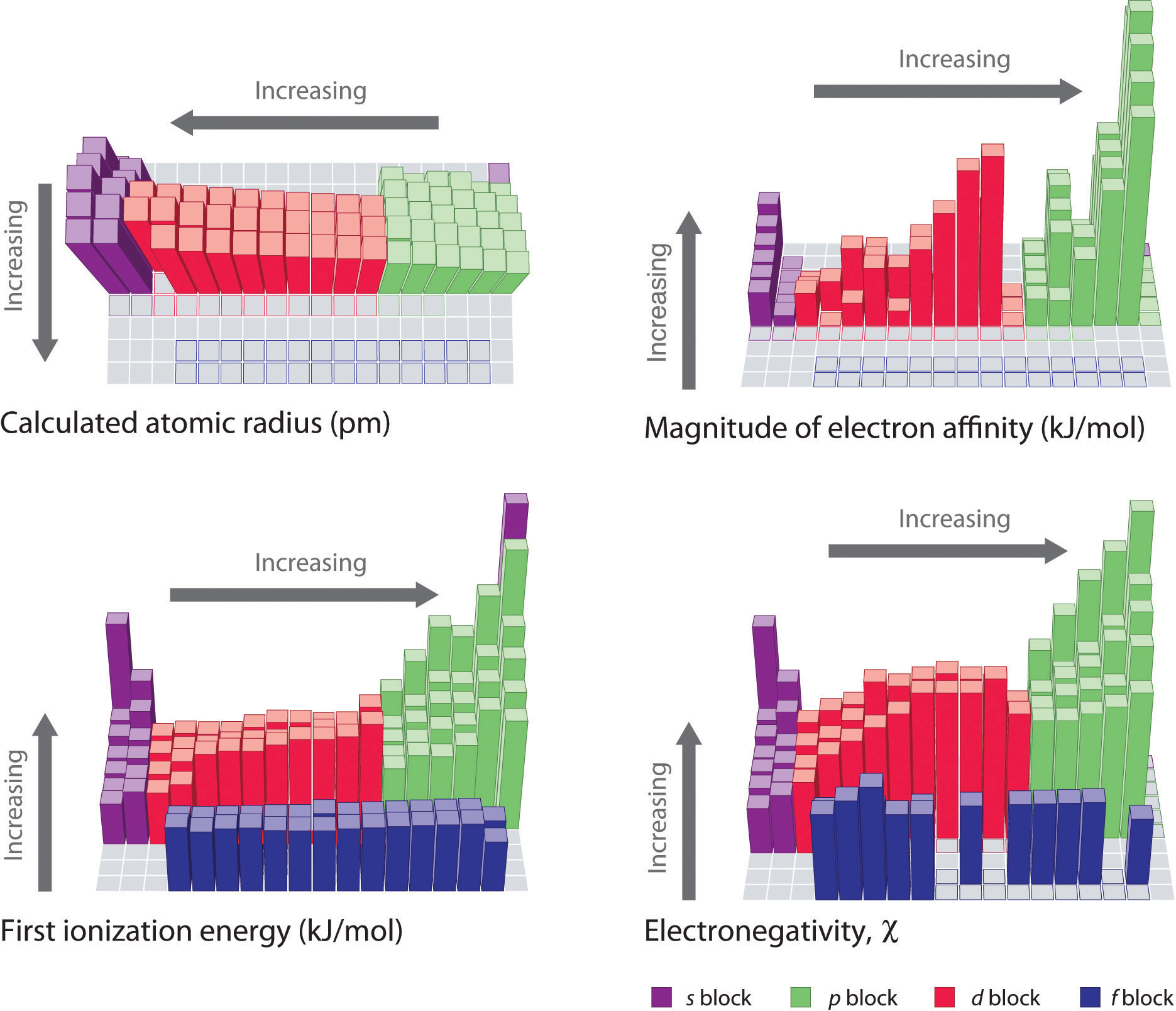
Now, help the kids see the patterns. I use Electronegativity to explain the concept of periodic trends or patterns in the Periodic Table. Linus Pauling was a professor and used a GPA scale to compare an element's ability to grab electrons. My kids study this trend first, particularly Group I and Group 7 elements. Periodic Trends are described going from left to right on the Table and top to bottom in each group, typically involving only 'main group' or representative elements.
Once the class has the idea of a trend, each child or group receives a different trend: electron affinity, metallic and nonmetallic character, first ionization energy, atomic radius, ionic radius, density, melting point, boiling point, and electronegativity. I chose metallic and nonmetallic character, atomic radius, and first ionization energy this time. When I have a large group, pairs of students get a trend to model. The team must define the trend, describe the trend, and defend their model. When I have a big class, I set out a variety of materials for their models: paper plates, reaction plates, toothpicks, straws, markers, etc. This time, I elected to have the Co-op use the straws, reaction plates, and clay. I did insist they measure the straws to make them proportionate.
We did not have time for the Periodic Tend Game; but I did show the kids how to play. Basically, you throw a die on a Periodic Table. When it landed, I asked the kids to estimate the element's electronegativity, relatively high or relatively low, and explain.


No comments:
Post a Comment