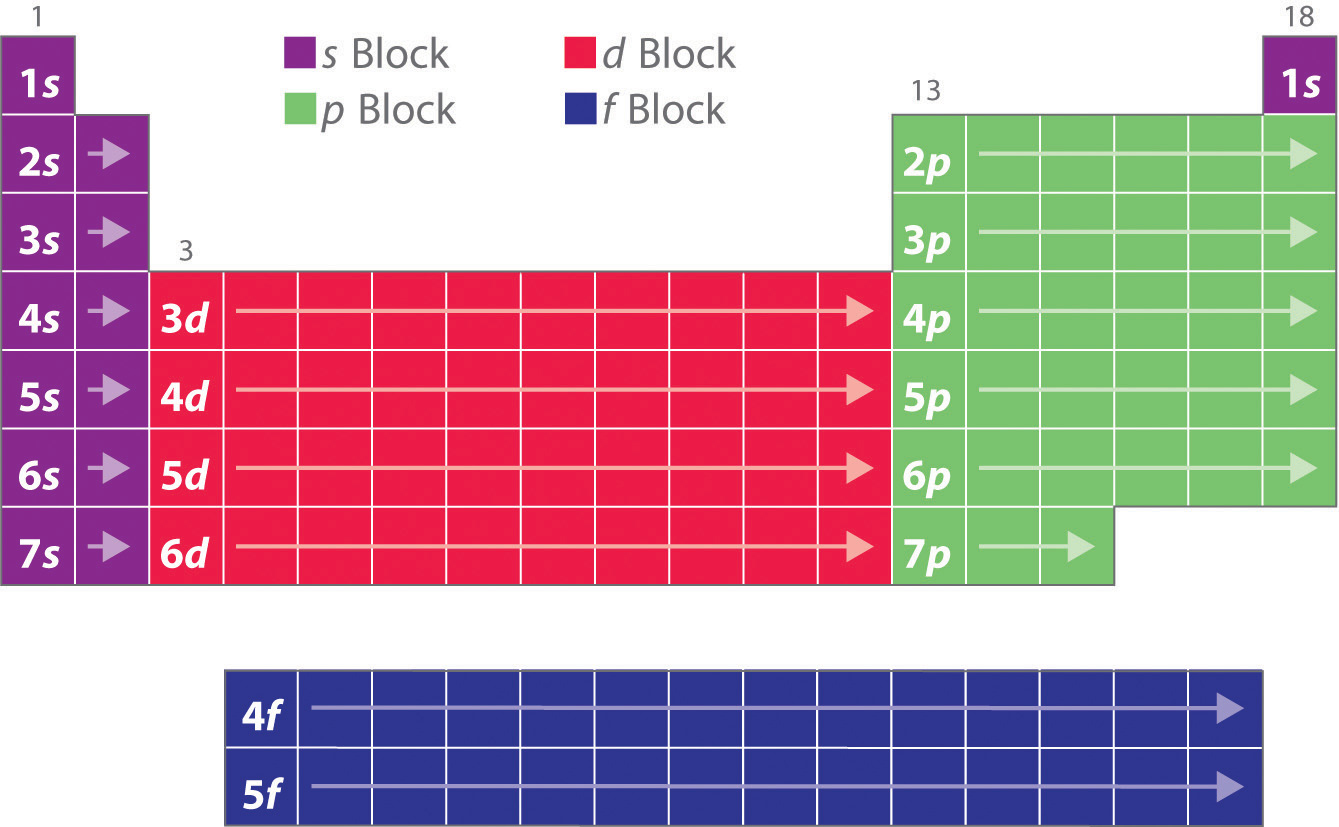
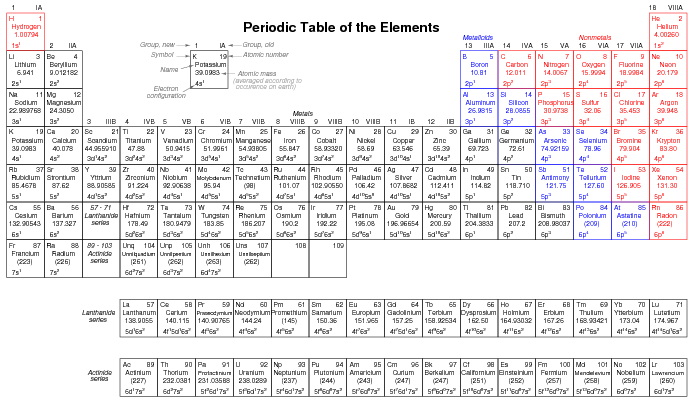
Last week the Chemistry class discussed electron configurations in the context of Quantum theory. Today, we reviewed how to write configurations using a chart similar to Chem Tutor Electron Configuration Scheme, and Tutorial which helps kids understand the mechanics of assigning electrons. In Module Seven, of Apologia's Chemistry text, Dr. Wile instructs students to use their periodic tables to assign the electrons and determine their configurations. This Periodic Table identifies the different 'blocks': s block, d block, p block, and f block, which means their valence electrons are in the s, p, d, or f orbitals. This Periodic Table has the orbitals identified. For example, Scandium is labeled '3d1' and Titanium is 3d2. This Chart has the electron configurations superimposed on the Periodic Table. The bottom live is to connect the idea that the rows or periods on the Periodic Table are energy levels. The elements are grouped by their number of valence electrons.
Understanding how to write electron configurations can take some time. Initially, the kids need to start at Hydrogen and write them one at a time, checking their work to see if it is correct. Once they get the mechanics, orbital diagrams, orbital notation, and a short-hand method can be introduced. We also went over two exceptions, Cr and Cu. Assuredly, this is a lot for one lesson. I use electron configurations to show why metals tend to form positive ions and nonmetals tend to form negative ions. Metals, such as Na or K need only to shed one electron to become stable; whereas F or Cl only need to gain one electron to become stable. Now is the time to point out that Noble gases do not react unless combined with Fluorine under extreme conditions because their electron configurations are already completely filled. It is important to draw these connections. I use the configuration to explain why the sodium ion is +1 and the chlorine ion is -1 and mention that both are so reactive they are combined into compounds as salt. I think Module 7 is a pivotal lesson in chemistry.
I do use worksheets for this unit and assign a timeline of the development of Atomic Theory and
Quantum Theory. Prentice Hall's worksheets are good to review the concepts: Electron Arrangement in Atoms, Electrons in Atoms, Electron Configurations, Electron Configuration Activity, and a Puzzle.



Subscribe to:
Post Comments (Atom)
-
The class is completing their Designer Baby blogs. Finally. Yes,I sat on top of them in class. I still think the time investment is wort...
-
 The Co-op is reviewing for a series of cell quizzes and beginning with paper plate cell cycle models and mitosis with yarn. The first t...
No comments:
Post a Comment