One of the Earth Science students, Ryan, is willing to share his blog at http://ryansavalanchesandlandslides.blogspot.com/
I had emailed his mom to make sure she and Ryan were on board. I wanted you all to see the results from this project. Ryan is a freshman. I was happy with his blog posts. See what you think.
Monday, March 23, 2015

Friday, March 20, 2015
WA Earth Science:Blog Project
The blogs are still in varying states of completion. The kids wrote and posted test questions for their peers to answer using the resources provided in their blogs. The class was instructed to post their answers as comments or in an email. I hope to share one of the blogs after receiving permission from the student and his mom and dad.
Thursday, March 19, 2015
Designer Babies Life Science Project
The Life Science class is mid-way through the Designer Baby project. This group of sixth and seventh graders were instructed to create a blog. In their blogs, the kids are answering several questions:
1. What is a designer baby?
2. What is In Vitro Fertilization or IVF?
3. What is Pre-Genetic Diagnosis?
4. What are 'savior siblings'?
5. Where do you stand? Should parent's design their babies? What does the existing technology allow? Where do experts see designer babies heading in the future?
Some students breeze through these types of assignments; so, I added a little for them. Jodi Picoult's novel, 'My Sister's Keeper' centers on a 'savior sibling'. Her novel, 'Handle With Care', addresses the issue of 'wrongful birth' law suits. There are plenty of web sites that discuss these two books. I asked the kids to see if they could locate case studies, too.
The kids have creative freedom and may add videos, web sites, images, and links to their blog posts. This project has benefits for students with learning differences, who may gravitate to videos for their explanations. Gifted students might do compare the case studies and post their opinions. My goal is to inject a bit of technology and get the class to write.
WA: Life Science Comparative Morphology
The Life Science class is starting the unit on animals, next week and will perform several dissections. First an overview Comparative Morphology.
Wednesday, March 18, 2015
Apologia and WA Physical Science: Blog Project for Forces and Motion
This week all of my Physical Science students began a blog project. I am a believer in authentic, alternative assessment, such as a juried science fair competition. I subscribe to the theory that the kid should be able to demonstrate his or her understanding in greater depth than just passing a multiple choice test. The blog project is an assessment of Modules 9-13 in Apologia's Physical Science text. Here is the challenge: the kids have to decide which are the key concepts in Modules 9-13, select representative problem sets, demonstrate how to solve these problems, select activities and labs, and document all of these components in a blog. The kids set up their blogs and wrote introductions. (I have six students in this Co-op class and two kids drew names for partners.) Each student must write, instruct, and video problem solutions correctly with units. I recommend practice and for them to upload their videos to my YouTube channel. YouTube videos are a cinch to upload to Blogger. (Note the clapper icon on the tool bar.) It is especially easy to embed your videos from YouTube to Blogger using an iPad or a laptop. The kids will need a gmail account to access Blogger. I recommend that they use a parent's gmail account; the parent can access and delete at will. The trickiest aspect to setting up a blog is the unique address; Blogger will indicate whether or not the address selected is available. The kids will want time to customize their backgrounds. Be sure to have them show you their results. Stay tuned!
Apologia Chemistry: Even More on Electron Configurations
One thing that helps kids to write electron configurations is a chart. Here are two my students have found to be helpful. Chemistry Tutor has a good explanation for using these charts. My kids are in the middle of practicing how to use the chart, interpret configurations, short cuts, and other orbital diagrams-all while associating the configurations to the elements on the Periodic Table. Whew!


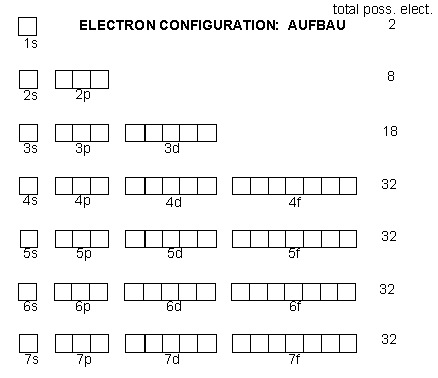
Apologia Chemistry: Even More on Electron Configurations
My kids are finishing time-lines on the history and development of Atomic Theory and Quantum Mechanics. Electron configurations are key to better understanding why groups of elements belong together in rows and periods. These two videos outline the history and explain how to assign electrons into configurations.
Apologia Chemistry: More on Module 7
Apologia Chemistry: Quantum
The kids are finally in Module 7. I know, I know! How are we going to finish by the end of May? We are meeting two mornings this week and next, doubling our co-op contact hours. We will regroup next Friday to see how many extra sessions are needed to finish well. The kids wrapped up the Can You Make 2 Grams Lab and weighed their precipitates today, which they allowed to dry a week. I went over my guide for writing a lab report with the kids. (See the earlier post.) I also reviewed how to calculate percent error from their results. We discussed potential sources of error; H. said that some of the filtrate may be in the filter paper. She forgot to write the weight of the paper in pencil on the filter paper to avoid scraping off the results and reducing the amount recovered.
Module 7, at last! Earlier, the kits did a flame test lab I purchased from Home Science tools, which came with a spectroscope. The video above is from one of my public school classes doing flame tests. Today, we went over the development of Quantum Theory and how to write electron configurations. More on the next post.
Friday, March 13, 2015
Apologia and WA Physical Science: Create a Physics Blog!
I teach both a Co-op class and at a private school. My Earth Science class is creating a blog which has been a hit. We missed so much class time, I had to get creative. It occurred to me that a blog would be perfect to sum up a unit on Forces and Motion that both of my Physical Science classes at WA and the Co-op are doing, now. For my purposes, this blog is a form of alternative assessment and exposes kids to new tools. My philosophy is that technology supports instruction; certainly kids need exposure to technology, but in ways that enhance instruction.
First, the kids need a gmail account to access Blogger. The kids can use a parent's account and their posts can remain private. That is a parental decision. My kids like to publish their work publicly and monitor the number of views. I have them send me the links to their blogs for evaluation. Here is what the Physical Science students are going to do. After they set up a blog, the kids need to identify all of the key terms, ideas, formulas, and units under the heading of Forces and Motion. My kids just created concept maps with these terms. The concept maps can be created electronically using free IHMC cmap tools. The Cmaps can be saved as jpg or pdf files and posted to their blogs.
Once the kids decide which ideas or concepts are most important, they should try to locate a demonstration or lab activity which explains the concept. We are doing a bunch of fun experiments which the kids have videoed and described. My kids are going to practivce the activity, video it with an explanation, post it to you-tube, and embed the videos in their blogs.
The kids have also done several problem sets. I am going to have them post sample problems and locate video, say Khan Academy, which instructs kids how to do the calculation. Alternately, the kids can write out the problems and explain how to proceed to solve them. There are several types of basic calculations. The kids can use their notes, problem sets, and texts to decide which problems to demonstrate.
Lastly, the kids are going to locate games, virtual labs, webquests, songs, etc. for their blog. I will keep you posted on their progress. With a parent's permission, I will link to their blogs so you can see the results. My Co-op has already posted many videos to You-tube; I think they are going to like this project.
First, the kids need a gmail account to access Blogger. The kids can use a parent's account and their posts can remain private. That is a parental decision. My kids like to publish their work publicly and monitor the number of views. I have them send me the links to their blogs for evaluation. Here is what the Physical Science students are going to do. After they set up a blog, the kids need to identify all of the key terms, ideas, formulas, and units under the heading of Forces and Motion. My kids just created concept maps with these terms. The concept maps can be created electronically using free IHMC cmap tools. The Cmaps can be saved as jpg or pdf files and posted to their blogs.
Once the kids decide which ideas or concepts are most important, they should try to locate a demonstration or lab activity which explains the concept. We are doing a bunch of fun experiments which the kids have videoed and described. My kids are going to practivce the activity, video it with an explanation, post it to you-tube, and embed the videos in their blogs.
The kids have also done several problem sets. I am going to have them post sample problems and locate video, say Khan Academy, which instructs kids how to do the calculation. Alternately, the kids can write out the problems and explain how to proceed to solve them. There are several types of basic calculations. The kids can use their notes, problem sets, and texts to decide which problems to demonstrate.
Lastly, the kids are going to locate games, virtual labs, webquests, songs, etc. for their blog. I will keep you posted on their progress. With a parent's permission, I will link to their blogs so you can see the results. My Co-op has already posted many videos to You-tube; I think they are going to like this project.
Wednesday, March 11, 2015
Apologia and WA: Penny and Balloon
The Penny in the balloon demo became more of an experiment. The kids started with pennies, tried dimes (the serrations burst the balloon), washers, foreign coins, ping pong balls, and water. So a simple demo became an active inquiry activity. Fun! One mor note. I like the kids to film their demos as a form of informal evaluation by adding an explanation for the demo or lab. Here is the video, one more time.
Subscribe to:
Posts (Atom)
-
The class is completing their Designer Baby blogs. Finally. Yes,I sat on top of them in class. I still think the time investment is wort...
-
 The Co-op is reviewing for a series of cell quizzes and beginning with paper plate cell cycle models and mitosis with yarn. The first t...